Showing posts with label JFK assassination. Show all posts

Sunday, March 24, 2024

Read/Listen: "Rick Sterling on Political Weaponization of Sports & JFK-Israel" by Kevin Barrett


Click here for Exit the Cuckoo's Nest's posting standards and aims.

Click here to sign the People's Proclamation and send it to everyone you know.

e
 
Kevin’s Newsletter
TRUTH JIHAD RADIO
Rick Sterling on Political We…
0:0056:15

Rick Sterling discusses his new article “Olympic Doping Case, Global Politics and the Sacrificing of Kamila Valieva: Here is how the West robbed and abused the best figure skater in the world, Kamila Valieva, while provoking the war in Ukraine.” His conclusion: “it is likely that US secret services intentionally created this situation to prevent Russian achievements at the Beijing Olympics and ‘unbalance’ the adversary.” We’ll also discuss his previous article “From Dallas to Gaza: How JFK’s Assassination Was Good for Zionist Israel.“

Excerpt from the end of the interview:

Of all the people who are masters of really grotesquely mendacious propaganda, the Zionists probably win the prize. And so let's talk about your other article, “From Dallas to Gaza, How JFK's Assassination Was Good for Zionist Israel.”

You're not the only person who's been saying things like this. Ray McGovern, for example, just recently in an interview with Judge Napolitano, made a kind of similar, much shorter remark that suggested that he was aware of the case that was first developed by Michael Collins Piper that Israel played the lead role in the Kennedy assassinations.

Your article doesn't really get into the pinning of the responsibility of the assassinations. It simply points out who benefits, and that most people—like I was a Kennedy assassination buff from the mid 1970s through the early 1990s, I don't remember anybody noticing that Israel had benefited so greatly from the assassination.

Right. It's been extremely well hidden. And I was very surprised myself to discover all these things. And I did it because I helped to organize an event in November of last year which was the 60th anniversary of the JFK assassination.

So in the course of, and I've written previous articles about JFK and foreign policy. There's the book, JFK and the Unspeakable, which is very good and which has a lot of information about JFK's moves toward peace and negotiation and compromise with the Soviet Union. He really had a very different notion of foreign policy. The Vietnam War would very likely not have happened if he had continued as president. The assassination or the coup in Indonesia in 1965 would not have happened. In fact, he had accepted an invitation from Sukarno to visit Indonesia. So he was friendly to President Sukarno of Indonesia, who was a leader of the Non-Aligned Movement.

So he had a completely different foreign policy, and I was very much aware of that. But as I started looking into it—and I've always been interested and concerned with the situation in Palestine and Israel—I started looking, seeing things that were really interesting, and specific cases (including) the literature that's come out in the last few years about Dimona, the nuclear facility in Israel, and the development of the nuclear bomb at Dimona and the war of words through secret letters between the Israeli Prime Minister Ben Gurion and Kennedy.

Some of this documentation has only been released in recent years. And when I looked at the actual letters, it was astounding because in diplomatic language, JFK was laying down the law. He was giving the ultimatum to Ben Gurion that the U.S. needed to inspect this nuclear facility that was under construction at the time.

And then I started looking into other elements and I discovered, to my surprise, at that time in 1963, the U.S. was not giving any military aid to Israel. All it gave was food and humanitarian supplies. And the U.S. was supporting the Palestinian right of return, U.N. Resolution 194.

And of course, I knew from the past that Kennedy had been very friendly with Gamal Abdel Nasser, the nationalist president of Egypt, and that Kennedy had supported Algerian independence against France.

So it became clear that Kennedy really was on a different wavelength and was conducting a very different policy than than not only is it happening now, but happened immediately after his death.

Another interesting element is that the parent organization that gave birth to AIPAC was the Zionists of America and the Kennedy administration was adamant that they needed to register under the FARA Act as foreign agents. You can imagine how big a change that would be if AIPAC was not allowed to do all the sorts of things that they're able to do, and be recognized as agents of a foreign country and required to fulfill all the obligations that organizations so designated have to comply with.

So I identified the four different areas where Kennedy's policy was really different and how the evolution of Israel could have been really different than it has been. LBJ was completely subservient to Israel and dependent on Israel. Kennedy's death and LBJ's assumption of the presidency really cemented hardcore Zionism and prevented the possibility of a peaceful resolution whereby the Jewish people in Israel and the Palestinian people could find some kind of a workable compromise.

And that's what JFK was working towards and that's what ended.

It was also news to me and very interesting that there was a lot of opposition to Zionism, and to a militant supremacist state of Israel, both within Israel and within the American Jewish community. In fact, my article was just recently reprinted by the American Council for Judaism, which at the time in the 1940s and 50s and even into the 60s was a very prominent Jewish organization. It was anti-Zionist.

And so a lot of bad things happened with the JFK assassination.

That's putting it mildly. You quote JFK as telling the Zionists, quote, “I cannot believe that Israel has any real desire to remain indefinitely a garrison state surrounded by fear and hate.” Well, that could have been said last week, right?

This new Nakba might be even worse than the first one. And the first one has earned them the absolute enmity of a billion people in their region. And this one—you know, it's going to be off the charts. Do they really think that this is a good way to get on in that region and in the world?

Yeah, I think that's a great quote from JFK. It’s from a speech he was campaigning to be president in 1960. He was speaking before the Zionists of America. And he said various complimentary things about Israel, but Kennedy was clear. He spoke clearly. He spoke without subterfuge. It wasn't just a PR exercise or a campaign promotion.

And as you say, that sentence could have been delivered last week. And it's definitely the case that they have followed the path of—Kennedy said he hoped they wouldn't be, or he couldn't imagine that they would want to be, a garrison state surrounded by fear and hate, but that's obviously what—

It was a failure of imagination.

I guess it's what they wanted in a way, but they claim they want security. The Zionists always claim they want security and that's why they “have to eliminate Hamas.” Well, they're doing it by killing tens of thousands of people. They're just engendering more hate.

It just seems kind of preposterous that they really think that implanting the settler colony in this part of the world and making the whole region just absolutely loathe them is somehow going to work out well for them. It's just mind boggling. There are various analyses of where that mentality comes from. I know you mentioned that you've read Lauren Guyenot's book, JFK 9-11. Laurent Guyenot also wrote From Yahweh to Zion, which I translated and published. It’s an analysis of Jewish identity politics and the influence of Jewish religion on it over the centuries. And he speculates that there is actually a religious factor involved. He thinks that the Torah or Old Testament is kind of at the heart of it.

But we are seeing now a kind of a rethinking by a lot of people looking at the genocide of Gaza and the way it's being misreported in the media, and noticing that there's something very, very wrong here. Do you have any thoughts about what's led to this Zionist mentality that's so obviously genocidal and also self-destructive?

Yes. I think the Kennedy assassination was pivotal because before his assassination, there were strong voices (including) prominent Jewish voices in America, including Albert Einstein, who were vehemently against (hardline Zionism). They were calling the super Zionists terrorists and fascists. And there was the philosopher Martin Buber. There were a lot of prominent voices both within Israel and within the U.S. who wanted to find some kind of accommodation.

And it's interesting about JFK. He went there in 1939 and he spent some time in Israel. And then he wrote a very lengthy letter to his father about his observations. And one of his observations is still true today. He said it's very much divided between a hardcore fundamentalist community that is unwilling to make any compromise and a more liberal community that's really at odds with the hardcore religious fanatics.

But is that still true, Rick? Because the polls today show that from 2008 on, Operation Cast Lead and each of these mowings of the lawn in Gaza are supported by a near-unanimous chunk of Jewish-Israeli public opinion. Not the Arab-Israeli public opinion, of course. Arabs are 20% of the population of Israel. But among the Jews of Israel, 90% plus support these massacres and genocides.

So what's changed?

I spent the summer of 2007 living with a Palestinian family in Palestine, but traveling around Palestine and Israel. And I remember going to a rally in Rabin Square in Tel Aviv. And it was really heartening to see thousands of young Israeli families marching against the occupation, saying that you can't be democratic and Jewish at the same time. That was a contradiction of terms to say you're a democracy, but have preferential treatment for one ethnic group.

That was very heartening. It was a minority then. And I think you're exactly right that it's an even smaller minority now. The lock-hold of Zionist ideology, of ethnic supremacy, has really gained ground.

But the pivotal point about the JFK, what happened after his death was that the Zionists of America and AIPAC were not required to register as agents of a foreign government. The U.S. reneged on UN Resolution 194 respecting rights for Palestinian refugees and looked the other way as Israel proceeded to develop the nuclear bomb.

And then in 1967, of course, you had the Six Day War, which was pivotal, both within Israel and within the American Jewish community, because everybody loves a winner, and here they were winning in six days, and everything seemed to be rosy. That was a huge turning point. And even at that point you could tell the sense of impunity was pretty astounding. It was because LBJ was in office that the Israeli forces attacked the USS Liberty off the coast of Egypt during the Six-Day War, killed 34 US sailors, injured another 194, and tried to sink the ship with the intention of blaming it on Egypt and then consolidating the support of the US with Israel against Egypt and the Soviet Union.

That's what I think it was the objective. But in any case, that happened, and LBJ looked the other way. He said, “I can't allow our ally to be embarrassed” when a US ship has been directly attacked. But since then, it's gone on, up to the current time.

I think October 7 is reversing what happened in June 1967. The prison break that Hamas and other militant groups waged on October 7, successfully attacking military checkpoints and showing the weakness of the Israeli military, and then the subsequent inability of the Israeli military to crush Hamas, and the ongoing genocide, have reversed it.

The whole world is reacting with horror. And I think the false image of a supremacist and unbeatable Israel has been effectively ended.

Yeah, I agree. So where will it go? The U.S. empire seems to be losing in Ukraine and will very likely lose to China, which is still growing a lot faster than the U.S. and the West are, and then with this situation in Gaza where the whole global south, especially the nearly two billion strong Muslim world and certainly this region, is turning strongly against the U.S. and ready for a post-American empire world.

So at some point, will Israel either have to change or go down due to the U.S. empire no longer being able to prop it up?

Well, that's the $64,000 question. What will they do in failure, whether it's Israel or it's the United States? In some ways, they're kind of joined at the hip, unfortunately. It speaks very poorly of American democracy that you can have 75% of the U.S. population wanting a ceasefire in Gaza and yet the U.S. administration has consistently denied that. They vetoed it in the U.N.

And what's happened in the last 24 hours at the U.N. was kind of a smokescreen, it was a pretend ceasefire resolution from the U.S. which was vetoed by China and Russia because they didn't want to go along with a smokescreen pretend-ceasefire resolution that wasn't anything of the sort.

So it's bad for the U.S., it's bad for Israel. And how to find a way out of it? How to find a way out of the U.S. spending a trillion dollars a year on the empire as our own infrastructure falls apart, as society breaks up in Israel through all of its contradictions.

I guess the danger is that some crazies will get power and that that Israel will use a nuclear weapon, which they have, or the U.S. and their puppets in West Europe will keep provoking the situation there instead of realizing that it's not that bad if Ukraine is neutral. What's so bad about that? And if the people in the eastern Ukraine want to be part of Russia instead of Ukraine, that should be their right.

The people in Crimea—and I've been to Crimea twice, and it's it's not close. 90% of the population wants to be part of Russia.

What's so bad about Ukraine being neutral? And what's so bad about ending apartheid in Israel and having one person one vote? The Jewish people in Israel will do fine. They've got the education and all the advantages that they've had. What's wrong with having an equal state and ending apartheid and ending the occupation? It costs them a tremendous amount financially to maintain the apartheid state, to maintain the occupation. All of that could be done away with and they would have vastly more security if they didn't have their foot on the neck of the Palestinian population, which is about the same size as the Jewish population.

Wednesday, January 3, 2024

"From Dallas to Gaza: The JFK Assassination Was Good for Zionist Israel" by Rick Sterling


Click here for Exit the Cuckoo's Nest's posting standards and aims. 


FROM DALLAS TO GAZA: THE JFK ASSASSINATION WAS GOOD FOR ZIONIST ISRAEL


President John F. Kennedy was assassinated sixty years ago. If he had lived and won a second term, the Israeli-Palestinian conflict would have evolved differently. Possibly, the path toward Israeli apartheid and genocide in Gaza could have been avoided.

In his short time in office, Kennedy significantly changed U.S. foreign policy. As documented in the book “JFK and the Unspeakable: Why He Died and Why It Still Matters,” JFK resisted the CIA and military-industrial complex in the policies he set regarding the Third World and the Soviet Union. The Vietnam War, the assassination of Indonesia’s President Sukarno, and continued hostility to Cuba and the Soviet Union would not have happened had Kennedy lived and won a second term.

Less well known, Kennedy’s policies also challenged and opposed the military and political ambitions of  Zionist Israel. At the time, Israel had only existed for thirteen years. It was still evolving, and the course was not set. There was significant international resolve to find a compromise solution regarding Palestinian refugees from the 1948 Nakba. When Israel attacked Egypt and seized the Sinai peninsula in 1956, the Eisenhower administration demanded Israel withdraw from the captured territory. They complied.

At this time, in the early 1960s,  prominent Jewish voices criticized the racism and discrimination of the Israeli government. Israelis like Martin Buber assailed Ben-Gurion and noted that “At the inception of the state, complete equality with the Jewish citizens was promised to the Arab population.” Many influential Israelis realized their long-term security and well-being depended on finding a just settlement with the indigenous Palestinian population.

In the United States, the Jewish community was divided, and many were anti-Zionist. The American Council for Judaism was influential and anti-nationalist. The racist and aggressive character of Israel was not yet set in stone. Nor was American Jewish support for Israel. When Menachem Begin came to the United States in 1948, prominent Jewish leaders, including Albert Einstein, denounced him. They said Begin, who later became Israeli Prime Minister, was a “terrorist” who preached “an admixture of ultra-nationalism, religious mysticism and racial superiority.” Many American Jews had mixed feelings and did not identify with Israel. Others supported Israel but based on there being peace with the indigenous Palestinians.

There are four key areas where Kennedy’s policy substantially differed from what followed his death.

John F. Kennedy Israel
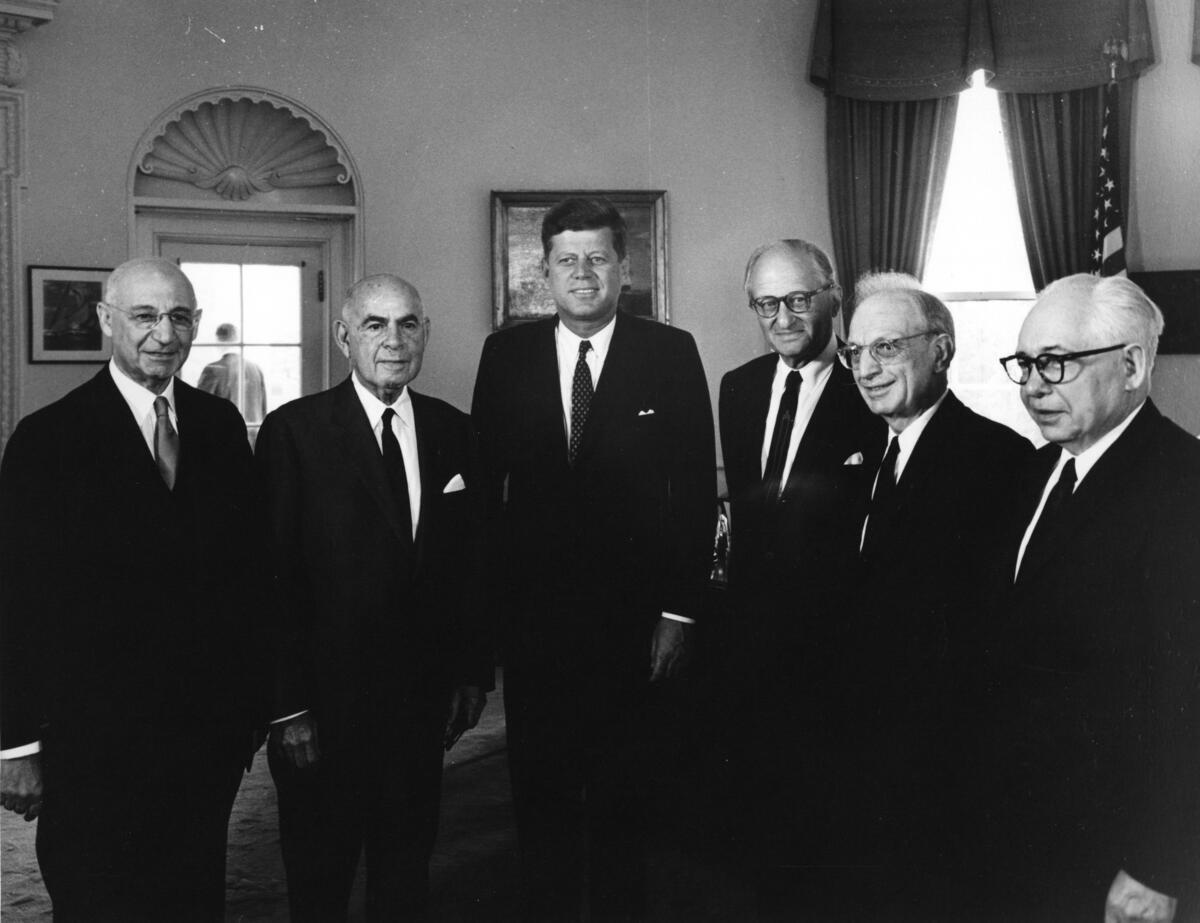
John F. Kennedy meets with members of the American Jewish Committee in the Oval Office, April, 1962. Photo | JFK Presidential Library


KENNEDY WAS NOT BIASED TOWARD ISRAEL

The Kennedy administration sought good relations with both Israel and the Arab nations. Kennedy aimed to extend U.S. influence throughout the Middle East, including with countries friendly with the Soviet Union and at odds with NATO partners.

JFK personally supported Arab and African nationalism. As a senator in 1957, he criticized the Eisenhower administration for supporting and sending weapons to France in their war against the Algerian independence movement. In a 9,000-word presentation to the Senate Foreign Relations Committee, he criticized “Western imperialism” and called for the U.S. to support Algerian independence. Algerian President Ben Bella, whom France had tried to assassinate and considered far too radical by many in NATO, was given an impressive welcome to the White House.

Kennedy changed the previous frosty relations with the United Arab Republic (Egypt and Syria) led by Gamal Abdel Nasser. For the first time, the U.S. approved loans to them. Kennedy wrote respectful letters to the Arab presidents before he welcomed Israeli Prime Minister Ben Gurion to Washington. The Arab leaders could see the difference and responded with appreciation. Those who claim there was no difference with Kennedy ignore that Egypt’s Nasser, Algeria’s Ben Bella and other nationalist leaders saw a big difference.

In 1960, when Kennedy was campaigning for the presidency, he spoke at the Zionists of America Convention. He made complimentary remarks about Israel but also expressed the need for friendship with all the people of the Middle East. He said the U.S. should “act promptly and decisively against any nation in the Middle East which attacks its neighbor” and “The Middle East needs water, not war; tractors, not tanks; bread, not bombs.”

Kennedy frankly told the Zionists, “I cannot believe that Israel has any real desire to remain indefinitely a garrison state surrounded by fear and hate.” By maintaining objectivity and neutrality on the Israeli-Arab conflict, Kennedy wanted to steer Jewish Zionists away from the racist, aggressive, and ultra-nationalistic impulses that have led to where we are today.


KENNEDY WANTED ISRAEL TO FOLLOW THE RULES

The second difference in Kennedy’s policy is regarding Zionist lobbying on behalf of Israel. Under the Foreign Agents Registration Act (FARA), organizations that promote or lobby on behalf of a foreign government must register and account for their finances and activities. Under Attorney General Robert Kennedy, the Department of Justice (DOJ)  instructed the American Zionist Council (AZC) to register as agents of a foreign country. AZC is the parent organization of the American Israel Public Affairs Council (AIPAC).

As documented in detail here, on November 21, 1962, the Assistant Attorney General wrote to them, “The receipt of such funds from the American sections of the Jewish Agency for Israel constitutes the (American Zionist) Council, an agent of a foreign principal…. the Council’s registration is requested.”

The emergence of Israeli political influence was also scrutinized in the Senate. Under Senator William Fulbright, the Senate Foreign Relations Committee held hearings in May and August 1963. They revealed that tax-free donations to the United Jewish Appeal, supposedly for humanitarian relief in Israel, were being channeled back to the U.S., where the money was used for lobbying and Israeli public relations.

Attorneys for AZC stalled for time. On August 16, 1963, a DOJ  analyst reviewed the case and concluded, “Department should insist on the immediate registration of the American Zionist Council under the Foreign Agents Registration Act.”

On October 11, the DOJ demanded that AZC register and the “Department expects a response from you within 72 hours.”

On October 17, a DOJ memorandum reports that attorneys for AZC pleaded for not being required to register as foreign agents. They offered to provide the necessary financial disclosures but that registering as a foreign agent “would be so publicized by the American Council on Judaism that it would eventually destroy the Zionist movement.” As indicated in this discussion, political Zionism was not yet dominant in the American Jewish community and was actively opposed by the American Council on Judaism—and other Jewish groups.


KENNEDY SUPPORTED PALESTINIAN RIGHTS

A third difference is regarding Palestinian rights. Although he was only 44 when he became president, Kennedy had more international experience than most U.S. presidents. In 1939, he spent two weeks in Palestine. He described the situation and difficulties in a lengthy letter to his father. He wrote, “The sympathy of the people on the spot seems to be with the Arabs. This is not only because the Jews have had, at least some of their leaders, an unfortunately arrogant, uncompromising attitude, but they feel that, after all, the country has been Arabic for the last few hundred years …. Palestine was hardly Britain’s to give away.”

In comments that are still true, Kennedy remarks how the Jewish residents are divided between a “strongly Orthodox Jewish group, unwilling to make any compromise” and a “liberal Jewish element composed of the younger group who fear these reactionaries.” His analysis is sympathetic to both Jewish and Arab peoples and addresses the difficulty but necessity of finding a compromise solution.

In the early 1960’s, the U.S. State Department was not locked into a biased acceptance or approval of Israeli policies. The U.S. supported U.N. Resolution 194, resolving (in paragraph 11) that “refugees wishing to return to their homes and live at peace with their neighbors should be permitted to do so at the earliest practicable date, and that compensation should be paid for the property of those choosing not to return and for loss of or property damage which, under principles of international law or equity, should be made good by the Governments or authorities responsible.” This has become known as the “right of return.”

John F. Kennedy Israel
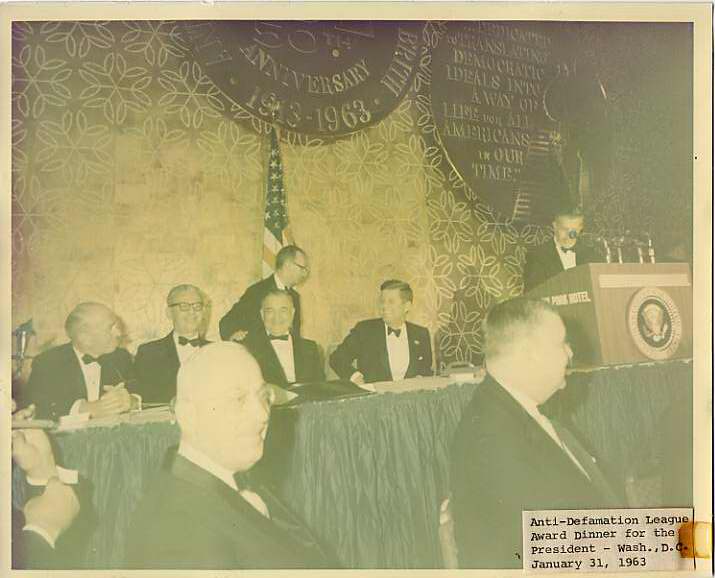
President John F. Kennedy, at the 1963 Anti-Defamation League Award Dinner in Washington, D.C.

On November 21, 1963, the day before Kennedy’s assassination, the N.Y. Times had two news stories that exemplified the discord between Washington and Tel Aviv. A report from the United Nations is titled “Israel Dissents as U.N. Group Backs U.S. on Arab Refugees.”   It begins, “A United States resolution calling for continued efforts to resolve the predicament of the Palestinian Arab refugees was approved tonight 83 to 1… Israel cast a single negative vote….The issue centers on a 1948 resolution whose key section, paragraph 11, concerns the future of the Arabs who were displaced from their homes by the Palestine conflict. They have been living in the lands bordering Israel …. The revised United States text calls on the Palestine Conciliation Commission to ‘continue its efforts for the implementation of Paragraph 11′.”

The second NYT story is titled “U.S. Stand Angers Israel.” It reports from Jerusalem that “Premier Levi Eshkol expressed extreme distaste today for the United States’ position in the Palestine refugee debate…. Israel’s anger was conveyed ‘in the strongest terms’ to the U.S. Ambassador …. The Israeli government is upset about the American resolution before the U.N. Political Committee and by American maneuvers over the issue.” Israel was angered and objected because the Kennedy administration was trying to resolve the Palestinian refugee situation, including the right of return.


KENNEDY TRIED TO STOP ISRAEL’S NUCLEAR PROGRAM

The fourth and most considerable contention between Kennedy and the Israeli leadership was regarding their developing nuclear weapons. This issue was so secret that crucial documents and letters have only been released recently.

President Kennedy was a strong advocate for stopping nuclear proliferation. After the 1962 Cuban missile crisis,  he realized how easy it would be to intentionally or accidentally trigger a catastrophic nuclear war. If nuclear weapons were allowed to spread to more countries, the risks of global catastrophe would be all the greater. It was also predicted that if Israel acquired nuclear weapons capability, they would become more aggressive and less likely to reach a compromise agreement regarding Palestinian refugees.

When intelligence indicated that Israel might be trying to build a nuclear weapon at Dimona in 1962, Kennedy was determined to find out if this was true and, if so, to stop it. This caused an intense diplomatic confrontation between JFK and Israeli Prime Minister David Ben-Gurion. The proof of this has recently been revealed in the exchange of letters between President Kennedy and  Prime Minister Ben-Gurion and his successor, Levy Eshkol. They are all labeled “Top Secret” or “Eyes Only”.

It is essential to see the sequence and some details to understand how intense this showdown was. These communications are all from 1963. (Author’s note: Skip to the next section if you wish to skip the details outlined in the following exchanges.)

In March, the U.S. State Department instructed the U.S. Ambassador to inform the government of Israel (GOI) that for “compelling reasons,” the “USG seeks GOI assent to semi-annual repeat semi-annual visits to Dimona, perhaps May and November, with full access to all parts and instruments in the facility, by qualified U.S. scientists.” (underline added)

On April 19, the State Department instructed the U.S. Ambassador to Israel to “press” for an “affirmative reply” to the earlier request for semi-annual inspections of Dimona.

On April 26, Israeli PM Ben Gurion replied to President Kennedy. He evaded the issue of nuclear facility inspections and instead expressed his concern regarding a recent proclamation from Egypt, Syria and Iraq. He compared Egyptian President Nasser to Germany’s Hitler.

On May 4, JFK responded to Ben Gurion’s concerns and underscored the U.S. commitment to Israel and peace in the Middle East. He told the Israeli leader he is much less worried about an “early Arab attack” than the “successful development of advanced offensive systems.”

On May 8, a Special National Intelligence Estimate concluded, “Israel intends at least to put itself in a position to be able to produce a limited number of weapons” and that “unless deterred by outside pressure [the Israelis] will attempt to produce a weapon sometime in the next several years.” The analysis predicted that if   Israelis had the bomb, it would “encourage them to be bolder in their use of the conventional resources, both diplomatic and military, in their confrontation with the Arabs.”

On May 10, the U.S. State Department sent an “Eyes Only Ambassador” telegram to the U.S. Ambassador to Israel. The ambassador was instructed to remind the Israeli leadership that they had previously agreed to the bi-annual inspections. The telegram also says Israeli concerns about Arab development of a nuclear bomb “are not valid” because there is nothing comparable to the “advanced Israeli program.”

The tensions between the Kennedy administration and Tel Aviv caused the Israel lobby to escalate pressure on the White House. This is revealed in a May 11 TOP SECRET State Department memo regarding “White House Concern with Arab-Israeli Matters.” It begins, “In recent weeks, as you are aware, it has become increasingly clear that the White House is under steadily mounting domestic political pressure to adopt a foreign policy in the Near East more consonant with Israeli desires. The Israelis are determined to use the period between now and the 1964 Presidential election to secure a closer, more public security relationship with the United States, notably through a public security guarantee and a cooler, more antagonistic relationship between the United States and the UAR [United Arab Repubic].” This fascinating memo shows Israeli influence in U.S. foreign policy and electoral politics. It further indicates Kennedy’s effort to mitigate this influence while standing firm on stopping nuclear proliferation.

On May 12, 1963, Ben Gurion wrote another long letter to President Kennedy. Again evading the U.S. request, Ben Gurion gives a distorted history, including the claim that Palestinian refugees left Palestine “at the demand of Arab leaders.” He again compares Nasser to Hitler and suggests the danger of a new Holocaust. He says, “Mr President, my people have the right to exist … and this existence is in danger.”

On May 19, Kennedy responded to Ben Gurion, emphasizing the importance he placed on not allowing the spread of nuclear weapons. “We are concerned with the disturbing effects on world stability which would accompany the development of a nuclear weapons capability by Israel.” Kennedy underscores the “deep commitment to the security of Israel” but says the commitment and support “would be seriously jeopardized” if the U.S. is unable to obtain reliable information about “Israel’s efforts in the nuclear field.”

On May 27, Ben Gurion responded to Kennedy, saying that the nuclear reactor at Dimona “will be devoted exclusively to peaceful purposes.” He counters Kennedy’s request for bi-annual visits starting in June by suggesting annual visits “such as have already taken place” beginning at the end of the year. The condition is significant because the previous “visit” to Dimona was restricted in time and space.

On June 15, Kennedy wrote to Ben Gurion after he had received a scientific evaluation of the minimum requirements for a nuclear site inspection; after welcoming Ben Gurion’s assurances that Dimona would only be devoted to peaceful purposes, Kennedy issued a polite ultimatum. “If Israel’s purposes are to be clear to world beyond reasonable doubt, I believe the schedule which would best serve our common purpose would be a visit early this summer, another visit in June 1964, thereafter at intervals of six months.” He specifies that  the “visit” must include access to all areas and “sufficient time be allotted for thorough examination.”

On June 16,  the U.S. Embassy in Israel reported that Ben Gurion resigned as Israel’s Prime Minister. This was a huge surprise; the explanation was that it was for “personal reasons.” Ben-Gurion likely knew the contents of the forthcoming letter from Washington (received at the embassy the day before). The impact of his resignation was to stall for time. U.S. Ambassador Barbour suggested waiting until the “cabinet problem is worked out” before sending JFK’s near ultimatum to the next Prime Minister.

Kennedy did not wait long. On July 4, he wrote to new Israeli Prime Minister Levy Eshkol. After congratulating Eshkol on becoming the new Prime Minister, he goes straight to the point “concerning American visits to Israel’s nuclear facility at Dimona.” Kennedy says, “I regret having to add to your burdens too soon after your assumption of office, but …” He then goes on to request inspections as was requested in the letter to Ben-Gurion and that “support of Israel could be seriously jeopardized” if this is not done.

On July 17, Eshkol wrote to Kennedy that he needed to study the issue more before responding to Kennedy’s request to visit Dimona. U.S. Ambassador Barbour added that Eshkol verbally conveyed that he was “surprised” at Kennedy’s statement that U.S. commitment to Israel might be jeopardized. Indicating Israeli defiance, Eshkol told the U.S. Ambassador, “Israel would do what it had to do for its national security and to safeguard its sovereign rights.”

On August 19, Eshkol wrote to Kennedy, reiterating Dimona’s “peaceful purpose” and ignoring the request for a summer inspection. He proposed the inspection take place “toward the end of 1963”.

On August 26, Kennedy wrote to Eshkol to accept the visit at year-end but emphasized that it needed to be done “when the reactor’s core is being loaded and before internal radiation hazards have developed.” Kennedy set these conditions because they were essential for determining whether the facility could be used for developing a nuclear weapon.

On September 16, the State Department prepared a Memorandum of Conversation with a counselor from the British Embassy. There was joint concern but agreement that  Dimona would be visited and inspected “prior to the activation of the reactor.”


AFTER THE ASSASSINATION OF JFK

After Lyndon Baines Johnson (LBJ) became president, U.S. Mideast policy changed significantly. LBJ told an Israeli diplomat from the start, “You have lost a great friend. But you have found a better one.” The Israeli publication Haaretz says, “Historians generally regard Johnson as the president most uniformly friendly to Israel.” The Washington Report on Middle East Affairs writes, “Lyndon Johnson Was First to Align U.S. Policy with Israel’s Policies” and “Up to Johnson’s presidency, no administration had been as completely pro-Israel and anti-Arab as his.”

On the crucial issue of the Dimona inspection, the Israelis ignored JFK’s condition, and the reactor went critical on December 26. When the inspection occurred three weeks later, they could not inspect the areas that had been irradiated. A handwritten comment on the report says, “We were supposed to see this first!” We do not know what would have happened if JFK had been in the White House, but given the intensity of his effort and deep convictions regarding the dangers of nuclear proliferation, it would not have been ignored as it was under LBJ.

Under LBJ, relations with Egypt deteriorated. The U.S. stopped providing direct assistance loans and grants to Egypt. The U.S. became increasingly antagonistic to President Nasser, as desired by the Israel lobby.

Lyndon Johnson Israel
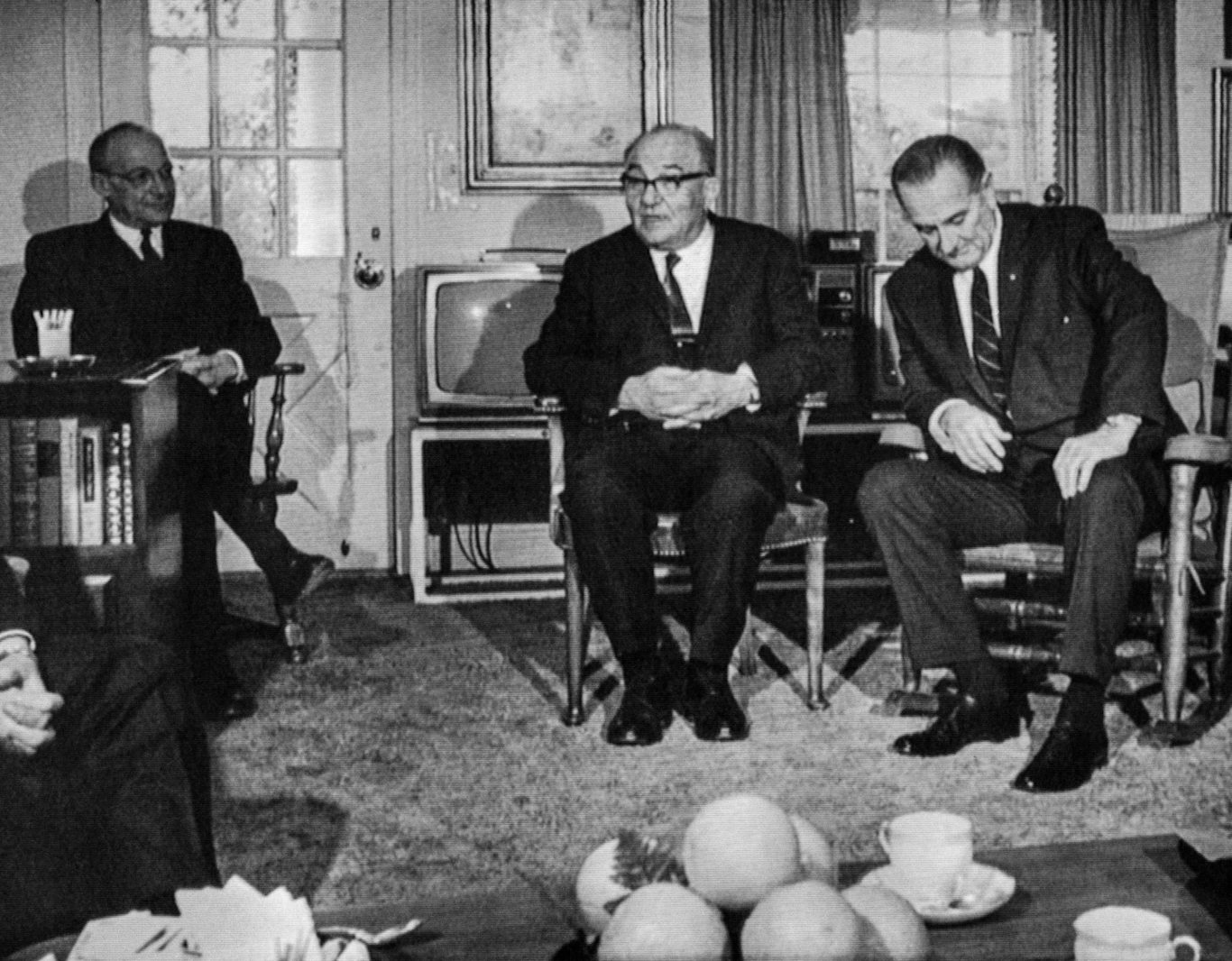
Lyndon Johnson, right, listens with head bowed as Israel’s Prime Minister Levi Eshkol, second right, chats with Dean Rusk at the LBJ Ranch in Stonewall, Texas, 1968. Photo | AP

U.S. support for a resolution to the Palestinian refugee issue decreased and then stopped.

The Department of Justice’s efforts to require the American Zionist Council to register as foreign agents became increasingly weak until they were dropped under LBJ’s new Attorney General, Nicholas Katzenbach. The sequence of exchanges includes:

On December 11, 1963, the AZC attorney wrote to the DOJ, saying, “Our client is not prepared to register as an agent of a foreign government.” Instead, he proposed to provide “voluntarily” the required financial information.

In January and February 1964, there were more exchanges between AZC and the DOJ. AZC expressed concern because the American Council on Judaism publicly said that AZC was acting as “propaganda agents for the state of Israel and that the Jewish Agency was being used as a conduit  for funds for the Zionist organization in the United States.”

In the summer of 1964, Nicholas Katzenbach became Attorney General. Negotiations continued. DOJ staff noted that AZC was “stalling” and not providing acceptable information despite the increasingly special and favorable treatment. In the spring of 1965, the DOJ accepted that AZC was NOT required to register as a foreign agent. Their financial information was kept in a unique, expandable folder. In November 1967, the American Israel Public Affairs Committee (AIPAC) applied for a federal tax exemption. The U.S. Treasury Department granted it, but it is backdated to 1953.


AN INCREASINGLY AGGRESSIVE, UNCOMPROMISING ISRAEL

The successful development of nuclear weapons added to Israel’s aggressive actions and unwillingness to resolve the Palestinian refugee crisis.

With intelligence information provided by Washington, Israel made a surprise attack on Egypt, Syria and Jordan in June 1967. The “Six-Day War” was a crucial turning point in Middle East history. Israel quickly defeated the unprepared combined armies. In the West, public perception of Israel changed overnight. The mythology of Israeli military (and general)  superiority was created. Among the American Jewish population, doubts and concerns about Israel evaporated, and support skyrocketed.

Israeli leader’s arrogance and deceit are exemplified by the attack on the USS Liberty during the Six-Day War. The communications navy vessel was monitoring the airwaves in the eastern Mediterranean when it was attacked by Israeli aircraft and boats. Thirty-four U.S. sailors were killed and 172 injured. Amazingly, the ship managed to stay afloat. The plan was evidently to sink the vessel, blame it on Egypt and consolidate U.S. support and hostility to Egypt and the Soviet Union.

Lyndon Johnson overruled the calls for help from the vessel, saying, “I will not have my ally embarrassed.”

The deadly incident was covered up for decades.

We do not know for sure what might have happened had JFK not been assassinated. It is possible  Kennedy warned in 1960, Israel has become a “garrison state” surrounded by “hate and fear.” The assassination of John F Kennedy ensured Zionist control of Israel, suffering for Palestinians, and permanent instability.

Feature photo | U.S. President John F. Kennedy meets with Israeli Premier David Ben-Gurion at the Waldorf Hotel in New York City on May 30, 1961. Photo | AP | Edits | MintPress News

Rick Sterling is an independent journalist in California’s San Franciso Bay Area. He can be reached at rsterling1@protonmail.comthat Israel would have been stopped from acquiring the bomb. Without that, they may not have had the audacity to launch the 1967 attacks on their neighbors, seizing the Golan, West Bank and Gaza Strip. If the Zionist lobby had been required to register as foreign agents, their influence would have been moderated. Perhaps Israel could have found a reasonable accommodation with Palestinians in one or two states.

Instead, Israel hardened into an apartheid regime, committing increasingly outrageous massacres. As

Disqus