As January became February, the International Court of Justice (ICJ) delivered a pair of legal body blows to Ukraine and its Western backers. First, on January 31, it ruled on a case brought by Kiev against Russia in 2017, which accused Moscow of presiding over a campaign of “terrorism” in Donbas, including the July 2014 downing of MH17. It also charged that Russia racially discriminated against Ukrainian and Tatar residents of Crimea following its reunification with Moscow.
The ICJ summarily rejected most charges. Then, on February 2, the Court made a preliminary judgment in a case where Kiev accused Moscow of exploiting false claims of an ongoing genocide of Russians and Russian speakers in Donbas to justify its invasion. Ukraine further charged the Special Military Operation breached the Genocide Convention despite not itself constituting genocide. Almost unanimously, ICJ judges rejected these arguments.
Western media universally ignored or distorted the substance of the ICJ rulings. When outlets did acknowledge the judgments, they misrepresented the first by focusing prominently on the accepted charges while downplaying all dismissed allegations. The second was wildly spun as a significant loss for Moscow. The BBC and others focused on how the Court agreed that “part” of Ukraine’s case could proceed. That this “part” is the question of whether Kiev itself committed genocide in Donbas post-2014 was unmentioned.
Ukraine’s failed lawfare effort was backed by 47 EU and NATO member states, leading to the farce of 32 separate international legal teams submitting representations to The Hague in September 2023. Among other things, they supported Kiev’s bizarre contention that the Donetsk and Lugansk People’s Republics were comparable to Al-Qaeda. Judges comprehensively rejected that assertion. Markedly, in its submitted arguments, Russia drew attention to how the same countries backing Kiev justified their illegal, unilateral destruction of Yugoslavia under the “responsibility to protect” doctrine.
This may not be the only area where Ukraine and its overseas sponsors are in trouble moving forward. A closer inspection of the Court’s rulings comprehensively discredits the established mainstream narrative of what transpired in Crimea and Donbas following the Western-orchestrated Maidan coup in February 2014.
In sum, the judgments raise serious questions about Kiev’s eight-year-long “anti-terrorist operation” against “pro-Russian separatists,” following months of vast protests and violent clashes throughout eastern Ukraine between Russian-speaking pro-federal activists and authorities.
In its first judgment, the ICJ ruled the Donbas and Lugansk People’s Republics were not “terrorist” entities, as “[neither] group has previously been characterized as being terrorist in nature by an organ of the United Nations” and could not be branded such simply because Kiev labeled them so. This gravely undermined Ukraine’s allegations of Russia “funding…terrorist groups” in Donbas, let alone committing “terrorist” acts there itself.
Other revelatory findings reinforced this bombshell. The ICJ held that Moscow wasn’t liable for committing or even failing to prevent terrorism, as the Kremlin had no “reasonable grounds to suspect” material provided by Ukraine, including details of “accounts, bank cards and other financial instruments” allegedly used by accused “terrorists” in Donbas, were used for such purposes. Moscow was also ruled to have launched investigations into “alleged offenders” but concluded they “d[id] not exist… or their location could not be identified”.
Nonetheless, the ICJ ruled that Moscow had failed “to investigate allegations of the commission of terrorism financing offenses by alleged offenders present in its territory.” This was due to the Kremlin not providing “additional information” upon Kiev’s request and failing to “specify to Ukraine what further information may have been required.” Ironically, judges conversely condemned Kiev’s allegations of “terrorism” by Russia as “vague and highly generalized,” based on highly dubious evidence and documentation, including – strikingly – Western media reports:
The Court has held that certain materials, such as press articles and extracts from publications, are regarded ‘not as evidence capable of proving facts.’
The ICJ was also highly condemnatory of the quality of witnesses and witness evidence produced by Kiev to support these charges. Judges were particularly scathing of Ukraine’s reliance on testimony supporting a systematic, state-sanctioned “pattern of racial discrimination” discrimination against Ukrainians and Tatars in Crimea since 2014. Statements attesting to this were “collected many years after the relevant events” and “not supported by corroborating documentation”:
The reports relied on by Ukraine are of limited value in confirming that the relevant measures are of a racially discriminatory character…Ukraine has not demonstrated… reasonable grounds to suspect that racial discrimination had taken place, which should have prompted the Russian authorities to investigate.
Elsewhere, Ukraine argued that “legal consequences” for residents of Crimea if they opted to maintain Ukrainian citizenship post-2014 and a “steep decline in the number of students receiving their school education in the Ukrainian language between 2014 and 2016,” amounting to an alleged 80% drop in the first year and a further 50% reduction in 2015, were signifiers of a discriminatory environment for non-Russians in the peninsula.
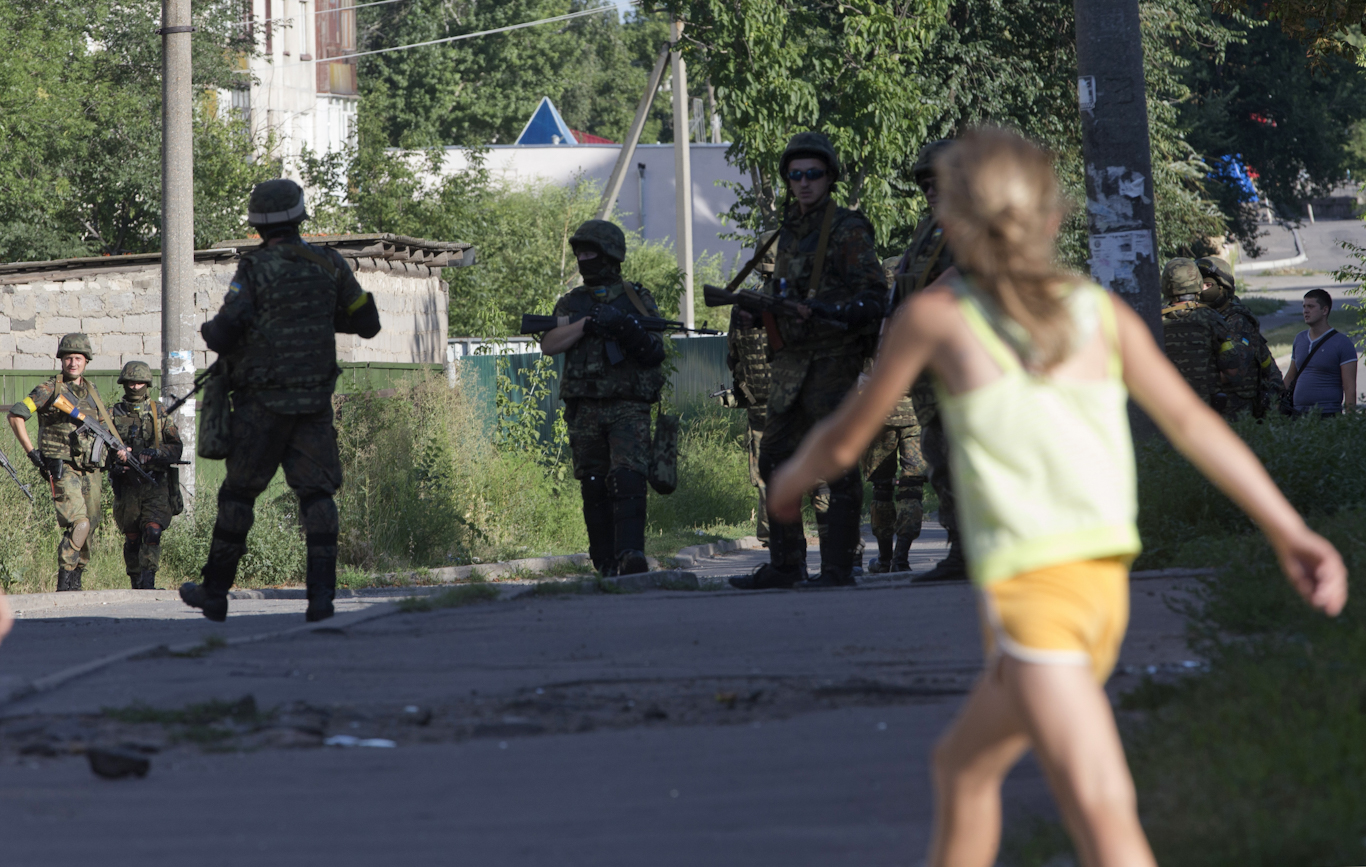
Ukrainian soldiers patrol alongsidethe Donbas Battalion, a Ukrainian militia, in Luhansk, July 26, 2014. Dmitry Lovetsky | AP
In support, Kiev submitted witness statements from parents claiming they were “subjected to harassment and manipulative conduct with a view to deterring” their children from receiving “instruction in Ukrainian,” which judges did not accept. By contrast, Moscow provided testimony not only demonstrating that parents made a “genuine” choice “not subject to pressure” to have their children taught in Russian but also “unresponsiveness on the part of parents to some teachers’ active encouragement [emphasis added] to continue having their children receive instruction in Ukrainian.”
The ICJ lent weight to these submissions, noting, “It is undisputed that no such decline has taken place with respect to school education in other languages, including the Crimean Tatar language.” Judges attributed much of the drop in demand for Ukrainian language “school instruction” to “a dominant Russian cultural environment and the departure of thousands of pro-Ukrainian Crimean residents to mainland Ukraine.” Moscow moreover “produced evidence substantiating its attempts at preserving Ukrainian cultural heritage and… explanations for the measures undertaken with respect to that heritage.”
Russia supplied documentation showing that “Ukrainian and Crimean Tatar organizations have been successful in applying to hold events” in the peninsula. In contrast, “multiple events organized by ethnic Russians have been denied.” Evidently, Russian authorities are even-handed towards Crimea’s population – the color of someone’s passport and their mother tongue are immaterial. On the same grounds, judges rejected Kiev’s accusation that “measures taken against Crimean Tatar and Ukrainian media outlets were based on the ethnic origin of the persons affiliated with them.”
Still, the Court contradictorily concluded Russia “violated its obligations of the International Convention on the Elimination of Racial Discrimination,” as Moscow “[did not demonstrate] that it complied with its duty to protect the rights of ethnic Ukrainians from a disparate adverse effect based on their ethnic origin.”
The prominent role of Banderite Neo-Nazis in Ukraine's government propaganda operations suggests that Nazi apologism has spread into the core institutions of its government – perhaps more than the dominant Western view is able to admit.
The ICJ has now effectively confirmed that the entire mainstream narrative of what happened in Crimea and Donbas over the previous decade was fraudulent. Some legal scholars have argued Ukraine’s acquittal on charges of genocide to be inevitable. Yet, many statements made by Ukrainian nationalists since Maidan unambiguously indicate such an intent.
Moreover, in June 2020, a British immigration court granted asylum to Ukrainian citizens who fled the country to avoid conscription. They successfully argued that military service in Donbas would necessarily entail perpetrating and being implicated in “acts contrary to the basic rules of human conduct” – in other words, war crimes – against the civilian population.
The Court’s ruling noted the Ukrainian military routinely engaged in “unlawful capture and detention of civilians with no legal or military justification…motivated by the need for ‘currency’ for prisoner exchanges.” It added there was “systemic mistreatment” of detainees during the “anti-terrorist operation” in Donbas. This included “torture and other conduct that is cruel, inhumane and degrading treatment.” An “attitude and atmosphere of impunity for those involved in mistreating detainees” was observed.
The judgment also recorded “widespread civilian loss of life and the extensive destruction of residential property” in Donbas, “attributable to poorly targeted and disproportionate attacks carried out by the Ukrainian military.” Water installations, it recorded, “have been a particular and repeated target by Ukrainian armed forces, despite civilian maintenance and transport vehicles being clearly marked…and despite the protected status such installations enjoy” under international law.
All of this could quite reasonably be argued to constitute genocide. Regardless, the British asylum judgment amply underlines who Ukraine was truly fighting all along – its own citizens. Moscow could furthermore reasonably cite recent disclosures from Angela Merkel and Francois Hollande that the 2014-15 Minsk Accords were, in fact, a con, never intended to be implemented, buying Kiev time to bolster its stockpiles of Western weapons, vehicles, and ammunition, as yet further proof of Ukraine’s malign intentions in Donbas.
The Accords did not provide for secession or independence for the Donetsk and Lugansk People’s Republics but for their full autonomy within Ukraine. Russia was named a mediator, not a party, to the conflict. Kiev was to resolve the dispute directly with rebel leaders. These were crucial legal distinctions about which Ukraine and its overseas backers were immensely displeased. They repeatedly attempted over subsequent years to compel Moscow to designate itself formally as a party to the conflict despite Russia’s minimal role in the conflict.
As a 2019 report published by the Soros-funded International Crisis Group (ICG), “Rebels Without A Cause” found, “the conflict in eastern Ukraine started as a grassroots movement… Demonstrations were led by local citizens claiming to represent the region’s Russian-speaking majority.” Moscow only began providing financial and material support to the rebels after Ukraine’s “counter-terror” operation in Donbas started in April 2014. And it was meager at that.
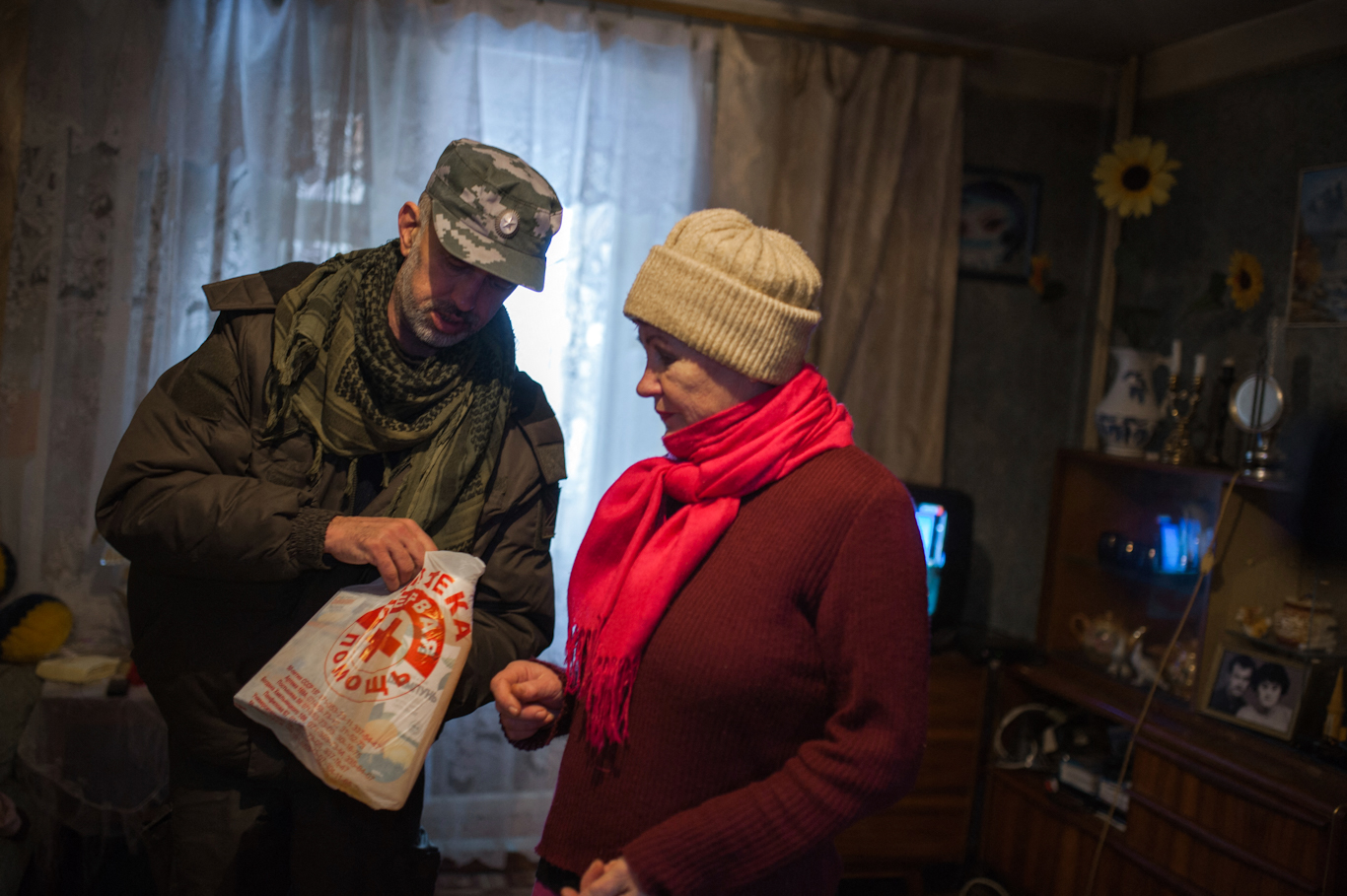
Volunteer pro-Russian fighters bring aid to civilians living in Donbas, February 01, 2022. Svetlana Kysilyova | Abaca | Sipa via AP
The ICG found that Russia’s position was consistent: the two breakaway republics remain autonomous subjects within Ukraine. This frequently put the Kremlin at significant odds with the rebel leadership, who acted in their own interests and rarely followed orders. The report concluded that Moscow was ultimately “beholden” to the breakaway republics, not vice versa. Rebel fighters wouldn’t put down their arms even if Vladimir Putin personally demanded them to.
Given present-day events, the report’s conclusions are eerie. The ICG declared the situation in Donbas “ought not to be narrowly defined as a matter of Russian occupation” and criticized Kiev’s “tendency to conflate” the Kremlin and the rebels. It expressed hope that newly-elected President Volodymyr Zelensky could “peacefully reunify with the rebel-held territories” and “[engage] the alienated east.”
The 2017 ICJ case explicitly concerned validating allegations of Russia’s direct, active involvement in Donbas. We are left to ponder whether this lawfare effort was intended to secure Kiev’s specious legal grounds for claiming it was invaded in 2014. After all, this could, in turn, have precipitated an all-out Western proxy war in Donbas of the kind that erupted in February 2022.
At the start of that month, French President Emmanuel Macron reaffirmed his commitment to Minsk, claiming he had Zelensky’s personal assurance it would be implemented. However, on February 11, talks between representatives of France, Germany, Russia, and Ukraine collapsed after nine hours without tangible results. Notably, Kiev rejected demands for “direct dialogue” with the rebels, insisting Moscow formally designate itself a party to the conflict in keeping with its past obstructionist position.
Then, as documented in multiple contemporary eyewitness reports from OSCE observers, mass Ukrainian artillery shelling of Donbas erupted. On February 15, alarmed representatives of the Duma, led by Russia’s influential Communist Party, formally requested that the Kremlin recognize the Donetsk and Lugansk People’s Republics. Putin initially refused, reiterating his commitment to Minsk. The shelling intensified. A February 19 OSCE report recorded 591 ceasefire violations over the past 24 hours, including 553 explosions in rebel-held areas.
Civilians were harmed in the strikes, and civilian structures, including schools, were apparently targeted directly. Meanwhile, that same day, Donetsk rebels claimed they thwarted two sabotage attacks by Polish-speaking operatives on ammonia and oil reservoirs in their territory. Perhaps not coincidentally, in January 2022, it was revealed that the CIA had been training a secret paramilitary army in Ukraine to carry out precisely such strikes in the event of a Russian invasion since 2015.
So, on February 21, the Kremlin formally accepted the Duma’s plea from a week earlier to recognize Donetsk and Lugansk as independent republics. And now here we are.
Feature photo | Pro-Russian Serviceman with a heavy machine gun observing the movement of Ukrainian troops from the advanced trenches of the people’s militia of the Donetsk People’s Republic in the Yasne village area, Donbas, February 11, 2022. Svetlana Kysilyova | Abaca | Sipa via AP2022. Svetlana Kisileva/Abaca/Sipa USA(Sipa via AP Images)
Kit Klarenberg is an investigative journalist and MintPress News contributor exploring the role of intelligence services in shaping politics and perceptions. His work has previously appeared in The Cradle, Declassified UK, and Grayzone. Follow him on Twitter @KitKlarenberg.
I’m old enough to remember hearing and seeing frequent references to something called “the rule of law.” Then in the post-9/11 era this vital phrase seemed to go the way of our dwindling freedoms, civil liberties and the tattered remnants of our democratic institutions. In the process of aborting the promise of decent human futures for most of the world’s people, the word, “law,” was pushed to the sidelines.
Where once we would have seen many references to the importance of making and enforcing good laws for the benefit of all people, that ideal has pretty much become mute and obsolete from the perspective of our puppeteered governors. When the concept of law is assertively put forward, it usually pertains to weaponized lawfare used in warlike attacks on the reputations, careers and economic viability of those that threaten the interests and authority of the rich and powerful.
The rules-based international order provides cover for the weaponization of law as a means for those with much power to maintain and augment their subordination of subjugated groups lacking access to power. The phrase, “rules-based international order” is repeated again and again in political communications, but especially in top-down communications during this era of rapid civilizational decline.
A rule is frequently much more flexible, fleeting, subjective and ephemeral than a law. All kinds of people, groups and organizations can make rules for a variety of purposes. Rules can be made almost anywhere, anytime. Rules can be made by anyone and rules may or may not be followed. Most of the time there are no serious consequences that flow from breaking a rule.
The requirements for making and enforcing laws are very different from the loose requirement involving rules. Only sovereign entities can make laws of the sort that police are duty-bound to enforce, sometimes to the point of pressing criminal charges when serious infractions occur. These days this kind of sovereign authority is mostly invested, theoretically at least, in countries.
Typically national constitutions situate the exercise of sovereignty in very explicit procedures involving many forms of interaction between people, elections, legislatures and courts. In some countries, where Muslim people predominate, the making, exercise and enforcement of laws draw on principles infused with religious understandings drawn from the Koran.
The United States also affords much room for the merger of politics and religion especially when it comes to the influential role of Christian Zionism in the formulation of public policy. The Christian Zionist role is most often to mobilize public support for US wars in support of the supposed interests of Israel.
Sovereignty and Law in Colonies, Empires and Nation States
Between 1945 and today, the number of countries belonging to the the United Nations went from 50 to almost 200. This near quadrupling of nation states in the world came about largely through the supposed decolonization of European colonies especially in Africa, the Indian subcontinent, Indochina and East Asia.
In the dominant system of international law, colonies were not considered sovereign nor were the inhabitants of colonies considered rights-bearing citizens. Rather the people in colonies were classified as disenfranchised wards subject to the sovereign jurisdiction of imperial authority over them. There were very large divides in the laws differentiating colonists from colonizers.
By 1945 Europe was exhausted from fighting two world wars in a period of less than half a century. As a result, European empires came unglued. In some instances decolonization was a relatively peaceful and amiable procedure. In other cases, as in Algeria, Vietnam, and Angola, the breakup was violent on both sides.
European colonies were processed through the new institutions of the United Nations to become the sites of nominally sovereign countries. This process of so-called decolonization, however, was hampered by the imposition of neocolonialist techniques. The continuity of entrenched patterns of subordination was maintained often through the imposition of new techniques especially through the agencies of debt enslavement. The global growth of debt enslavement is one of the main animating factors driving the operation of the rules-based international order.
The close association of various techniques of debt enslavement and the so-called rules-based international order is a big factor energizing countries that were once colonies of European empires to seek alternative banking arrangements. This movement involves the urge of many national governments to get out from underneath the military weight of the US Armed Forces combined with the financial weight of the US dollar and its attending institutions.
The monopolistic role of US dollar and the financial institutions it supports are generating the opposition of the BRICS and the Global South countries in their growing identification with the alliance between Russia, China and Iran. This emerging alternative to the rules-based international order emphasizes national sovereignty as a primary facilitator of national self-determination.
This quest to realize the potential of national sovereignty, however, is running up against those still pushing some of the deceptions integral to the rules-based international order. In recent times the pressure from this quarter to override national sovereignty continues to grow. The other side of the pre-emption of national sovereignty is the designation of topic-based centres of global sovereignty.
An obvious example is the current push by Big Pharma to make the UN’s World Health Organization the site of a claim to global sovereignty in health care and especially in the business of declaring pandemics. The huge scams and frauds associated with the manufactured COVID crisis point the way to more of the same from the hoaxers who operate in and around the WHO.
Quite clearly there is a powerful movement afoot to make the sketchy business of climate change the basis for some sort of topic-based sovereign centre in the style of the World Economic Forum.
The WEF is an unaccountable decision-making venue that, as is well known in Trudeau’s fiefdom of Canada, often pre-empts the sovereignty of national parliaments and legislatures. Canadians, for instance, find their election decisions count for naught when their Parliaments become useless because the big decisions are being made in Davos.
Power Grabs by Inter-Connected Networks of Self-Aggrandizing Swindlers
From what sources does the so-called rules-based order, both national or international, draw its principles, ideas and authorities? Where do the rules come from? From the United Nations? From courts of international law. From the World Bank? From treaties and conventions? From the Internet? From the Pentagon? From Labor Relations? From the EU? From law libraries? From stock markets? Black markets? Media cartels? From voting? From Rothschild intrigues? From academic conferences? From the work of fact checkers? From sacred scriptures? From research labs? From all of the above? From none of the above?
When it comes to the recent arrival of something labelled the rules-based international order, the origins lie more in power grabs by inter-connected networks of self-aggrandizing swindlers. As I view it, those who make claims to some kind of deep authority for a “rule-based order”are often seeking easy routes to obtain and augment influence for themselves and for their bosses.
References to rules-based order often comes from the lips of those who have never reckoned genuinely with the the requirements of scientific methodology or with the egalitarian principles integral to the realization of anything approaching democratic means of decision-making.
So let’s get real about what is really going on in the name of the rules-based international order. Let’s consider what this supposed order actually is, as well as what this grandiose phrase is meant to hide and conceal.
One of the keys to the so-called rules-based order is that the rules are decidedly different for different groups. This eclectic approach tends to announce the abandonment of principles emphasizing the application of universality, in other words, of equality before the law. Another key feature of the rules-based order is that there are whole classes of people who are basically exempted from having to adhere to any binding rules or laws at all.
These small groups who are put above the law, tend also to be the groups that by and large make the rules for everyone else. Average people are by and large denied any say whatsoever in deciding any aspect of the international rules-based order.
In the days when the rule of law was confidently placed in the forefront of some government operations, elections were the primary means for governors to obtain informed consent from the governed. These days, however, the role of the media is to deploy deception to produce uniformed consent in order to facilitate political agendas that often go against the basic rights and interests of most people.
Most elections these days are rigged. There are many well-established means of doing this cheating. One of the main techniques is through the exploitation of hackable systems of digital vote counting. Another common feature is the sabotage of elections by well-orchestrated networks of large media cartels.
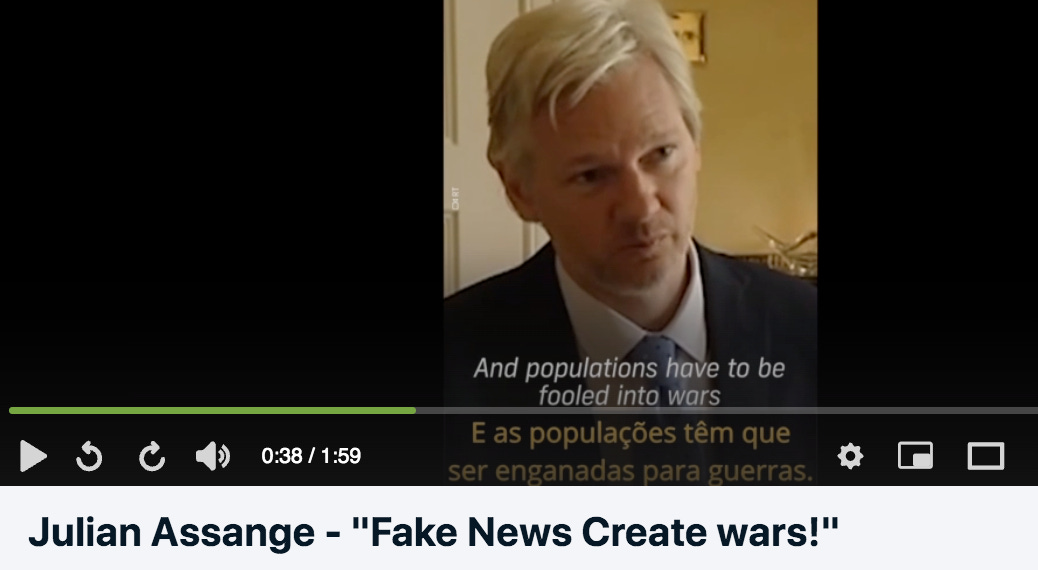
These communications cartels grossly misrepresent crucial issues central to the formulation of sound public policies. As Julien Assange indicates below, most populations do not like to go to war. Wars happen, nevertheless, because media venues play a major roles in “tricking” the public by publicizing litanies of lies.
The nature of warfare is changing rapidly as multiple governments are made subject to manipulations from above. Increasing this manipulation from above is aimed at eliminating, starving, enfeebling and impoverishing the governments’ own constituents. This phenomenon is well illustrated by the hundreds of millions of deaths and injuries purposely caused worldwide by the coercive pushing on populations of military bioweapons disguised as medical treatments for a supposedly new coronavirus.
The depopulation agenda was advanced in the course of the manufactured COVID crisis. This depopulation agenda continues to be promoted by the mass media’s 24/7 promotion of war, war and more war. Indeed, the business of mass communications has pretty much become intertwined with an array of mass murder rackets.
In the international rules-based order, there is plenty of room for special sets of rules for particular categories of criminal activity. These underground interactions include child trafficking, pedophilia rings intertwined with elaborate blackmail and espionage operations, the plundering and subsequent sales of human organs, black markets in armaments including weapons of mass destruction, the commerce of drug makers and drug pushers as exploiters of addictions, the smuggling of immigrants, and the killing, buying and selling of the last precious remnants of endangered wildlife.
Although these kinds of activities are outlawed, they are in fact made to form significant elements of the global economy. Such profitable criminal activities are well integrated into the matrix of the so-called rules-based international order. The funds generated easily find their way into large banking establishments that often have access to expertise in money laundering. The funds so generated often join other flows of ill-gotten capital into off-shore tax havens whose operations are inconsistent with the rule of law but completely consistent with the rules-based international order.
This so-called “order” exempts the rich from carrying the expense of governments while the much squeezed middle class wage earners are left to bear the cost of paying for government services and the interest payments on government debt paid mostly to the private central bankers in and around the Swiss-based Bank of International Settlements. To add insult to injury, the rich walk off with the privatized wealth from enterprises that often depend on substantial public investments along with sweetheart deals among political cronies.
This whole structure of legalized kleptocracy and fraud benefits the few at the expense of the the many. The sinister operation is defended, facilitated and augmented by large contingents of lawyers, prosecutors and judges who conduct their devious dealings behind the ornaments of law but not within the rule of law. The higher one goes up the scale from domestic law into international law, the more sordid, corrupt and deceptive the legal establishments become.
The groups and individuals that have effectively monopolized the largest share of wealth and power in the international rule-based order, mostly got where they are by slipping and sliding around both the laws and the rules. The ability to pull off such evasions often depends on working collaboratively with those charged to enforce the laws and the rules. Federal police operation like the FBI in the United States and Canada’s RCMP pretend to be law enforcement agencies but they are really very corrupt agencies of political theatre meant to advance the interests of their self-interested pay masters.
The ascendant class of serial law breakers tend to rule by transforming all regulatory and enforcement agencies into protection rackets to safeguard their own enterprises and interests. They are under no compunction to follow the rules they often make without accountability…. without obtaining anything resembling the informed consent of the governed.
The small number of people that dominate the governments and the media and the Internet and the courts and the professions and the unions and education and the cultural institutions are mostly servants of a system that concentrates massive political and proprietary control in the hands of a tiny minority. This minority operates above the law. These people are almost never held accountable for violating even the highest order of international criminal law.
The Savagery of Settler Colonies and Especially Israel
The expression of versions of sovereignty, gave legitimacy to “law” long before before the era when claims were made that some sort of rules-based order was the glue that would hold international society together. The concept of sovereignty became manifest in the evolutions of religiously-based ruling dynasties, some of which expanded into empires through conquest and diplomacy. The Aztec Empire of Mexico, or the Egyptian Empire of the Nile Valley, or the Persian Empire at Eurasia’s core, or the Macedonian Empire that briefly extended from Greece all the way to India, or the Chinese Empire, or the archetypal Roman Empire all had rich imperial histories long before the era of national states. The animating cultural force of the ancient empires often enlivens the heritage of the national governments that succeeded them.
Beginning in the 1500s and 1600s European polities, namely Portugal, Spain, France, Britain, the Netherlands, Belgium, and Germany created overseas colonies that became the basis of new forms of empire. Together these empires divided up almost the entirety of the Earth’s land mass. The lawyers of this era became very busy developing notions of sovereignty to concentrate law making authority in a few imperial capitals.
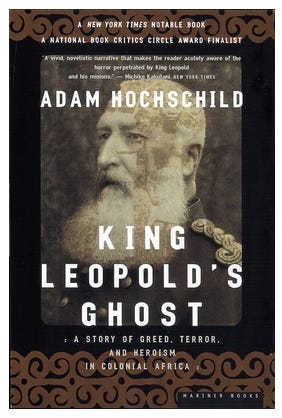
Darwinian social science in the Victorian era replaced Enlightenment era principles of universal human equality. Instead of affirming egalitarian ideals, the emerging social sciences ranked human beings on a vertical scale from savagery to barbarism to civilization. This paradigm was adopted by King Leopold of Belgium to justify his claim of the sovereign proprietorship over the Congo Free State in equatorial Africa.
King Leopold persuaded the United States and the European powers to accept his program submitted in 1885. He promised that he would govern the Congo to elevate through education the native savages into civilized people. Once he established his claim, Leopold used his status as absolute dictator to enslave his subjects in the work of rubber plantations.
In Canada it wasn’t until the 1960s that the Dominion government removed the category of savages and barbarians from the complex of laws and policies created specifically for the governance of registered Indians. Under Prime Minister John Diefenbaker, Indians could henceforth vote and run in national elections, enter into contracts by using their signatures, purchase alcohol, and borrow money in banks.
The maintenance of Darwinian paradigms of savagery and civilization facilitated the making of laws enabling European powers, their corporate extensions and their colonial emigrants to pretty much help themselves to whatever lands and natural resources they wanted on the expanding frontiers of empire. This kleptocratic system was made to be especially ruthless in its treatment of Indigenous peoples in those parts of empire where imperial expansion was accompanied by the migration of large contingents of non-native settlers that overwhelmed the Native peoples numerically, economically and culturally.
These regions where the the Indigenous peoples became small minorities compared to the immigrants and their descendants, have been identified as settler colonies. Many of the settler colonies in North America seceded from their British imperial parent to form the United States in America. The remaining settler colonies in the British Empire including Canada, Australia, New Zealand and Newfoundland, were sometimes referred to as White Dominions.
After 1911 many tried to construct the Union of South Africa as a White Dominion similar to, say, Canada. The governments of Canada and South Africa, who collaborated in their governance of Indian reserves and Bantustans, imposed policies that treated Indigenous peoples as uncivilized wards of the state. In the African polity, however, Black people were numerically dominant and eventually asserted against sometimes ruthless settler resistance, their constitutional status as equal individuals in the mix of citizenship with White people.
Israel turns out to have emerged as the most aggressive of all the settler colonies. I can think of no single genocidal event in the history in settler colonies more severe than what we have been witnessing in Gaza since early October. I cannot think of any Indian war or Maori war or Aborigines war or Kaffir war in South Africa to compare with the rapid fire, high-tech assault still underway in Gaza.
The colonization of the Israeli entity got off to a very bad start in 1947-48 after the General Assembly of the United Nations just barely squeezed out a majority vote on Resolution 181. The key features of Resolution 181 were the partition provisions dividing Palestine into to two sections, one for a new Jewish country and the other for a new Arab state. To this day the Arab state has yet to established. This outcome had the result of making many of the Palestinian survivors of Israel’s genocidal “War of Independence” in 1948, into stateless refugees.
From 1948 until today the genocidal assault on the native Palestinians has continued. The stateless refugees of the Gaza concentration camp were subjected to especially ruthless treatment culminating in the genocidal assault initiated in early October of 2023. It is readily apparent to those who have looked at the available evidence that considerable planning for this climactic genocide happened in the secret branches of the US and Israeli governments long before October 7.
The aim has been and remains to rid the Gaza strip of its 2+ million Palestinians inhabitants. The plan remains to exterminate as many Palestinians as possible by a lethal combination of technics, while while simultaneously destroying all housing, infrastructure and life support systems. The plan is to evict all survivors by forcing them to run for their lives away from a sterile death zone that the Jewish supremacists conducting the genocide want to transform into Jewish settlements.
When the Test of Legitimacy is What You Can Get Away With
It seemed until recently that the the US-Israel genocidal assault on Gaza was well within the purposely vague and ill-defined “rules-based international order.” This supposed rules-based order seems to thrive on operating outside the rule of law in the realm where might is right and the test of legitimacy is what you can get away with.
The settler colonialism of Israel was crafted into a defiant display demonstrating how many Israeli Jews have come to believe with some justification that they are not subject to any enforced limitations in their treatment of the Indigenous peoples. Many have come to embrace a self-perception that they are Chosen people considered to be above the law when it comes to the act of de-Palestinianizing Greater Israel.
For them ethnic cleansing was not to be considered a crime but rather a divine calling and a mission. The West Bank settlers with their laissez faire approach to murdering, torturing and jailing Palestinians seem to have become something of a caricature of the Cowboys and Indians culture of the American Wild West.
Then in the final days of 2023 the South African government submitted to the World Court a very solid indictment of Israel, accusing it of violating the Convention on the Prevention and Punishment of Genocide. Instituted in 1948, the Genocide Convention was a pioneering example of international criminal law very intertwined with the genesis of the UN’s International Court of Justice. (ICJ)
The ICJ agreed to accept the South African submission. The Court heard South Africa’s verbal arguments on January 11 and the next day it heard lawyers presenting a a defence on behalf of the government of Israel. Apparently Israel had never taken its place in the dock for the accused in any international proceeding.
Apparently up until 12 January, Israel basically ignored and boycotted any proceeding meant to hold them legally accountable for their treatment of the occupied people. The government and most of the people of Israel refused to acknowledge that Palestinians have a right of self-defence. They refused to picture themselves as Occupiers victimizing the Occupied People. Whatever happens, it seems, Jewish Israelis must always see themselves as victims.
Then on January 26 the ICJ came out with a historic ruling that acknowledged that a plausible instance of genocide was occurring in Gaza. The court did not order a cease fire. According to Michel Chossudovsky, the Court opted rather to call on the Netanyahu government to prevent and punish itself for possibly committing genocide.
Like many, I was initially very happy with the Court’s ruling. After years of seeing huge examples of obvious criminality taking place on many fronts at the the highest levels, apparently without legal consequences for the culprits, I wondered if the rule of law on the most important issues of our time had gone completely dormant.
The confidence of high officialdom in Israel that they could justify their obvious genocide by calling Palestinians animals and worse than animals, was hard to even fathom let alone absorb. Seeing hateful genocidal language put in the mouths of the Israeli children’s choir seemed to me like a whole new type of child abuse.
It also came as a shock that amidst all the factionalism among Jewish Israels, there seems to be no significant group focused on ending the genocidal assault because of the insanely lethal and injurious damage being done to Palestinian humans including droves of their children. It was daunting listening to that young Israeli soldier speaking openly about his wish to shoot Israeli children as if this lust to kill was the basis for some kind of wet dream.
Rethinking the ICJ Ruling in Light of the Observation That Netanyahu and His Cabinet Have Been Put in Charge of the Process of Investigating, Preventing and Punishing the Gaza Genocide
It has taken a while to sink in, but my appreciation of the ICJ ruling has dropped a few notches the more I contemplate the argument posed by Prof. Michel Chossudovsky in a running essay in Global Research.ca that he keeps revising since first publishing it on January 29. I currently have the Feb. 4 version in front of me. I’ll reproduce a large portion of the text below. The subtitle introduces the main thesis
The ICJ “Appoints” Netanyahu to “Prevent” and “Punish” Those Responsible for “Genocidal Acts”
The excerpt below starts with a part of the court order followed by Prof. Chossudovsky’s analysis of its meaning and implications
Court Order:“The State of Israel shall take all measures within its power to prevent and punish the direct and public incitement to commit genocide in relation to members of the Palestinian group in the Gaza Strip;…”
Analysis: What the ICJ judgment intimates is that the “Constitutionally Responsible Rulers (CRRs)” acting on behalf of the State of Israel, namely the members of Netanyahu’s Cabinet, are “Innocent”. They cannot “prevent and punish” themselves.
And that is where “Fake Justice” comes in
“Constitutionally Responsible Rulers (CRRs)” Netanyahu, Galant, Ben-Gvir, Katz, Smotrich, et al are the architects of the Genocide. Yet they have been assigned by the ICJ with a mandate “To Prevent and Punish the Direct and Public Incitement to Commit Genocide…”
The CRRs within Netanyahu’s Cabinet acting on behalf of the State of Israel-– who carefully planned prior to October 7, 2023 a genocidal attack against the People of Palestine, have been “appointed” by the ICJ to “take all measures within its power” to “prevent” and “punish”“public officials”, “private individuals”, andmembers of the Military who are carrying out acts of “direct and public incitement to commit genocide”.
Prevention and Punishment is not contemplated against Israel’s Netanyahu Clique of CRRs “who have blood on their hands.”
Under present circumstances, this “take all measures within its power” concept is tantamount to the criminalization of International Law: The CRRs “Criminals in High Office” (Netanayahu et al) are invited to take law enforcement in their own hands.
The option to entrust Netanyahu’s Cabinet with the “Prevent and Punish” assignment was a decision of the World Court. The 17 Judges could have demanded that the Israeli government cease all genocidal actions. They could also have recommended that the “prevent and punish” mandate be assigned to a United Nations body, including the UN Security Council.
The Netanyahu government has ordered the most hideous crimes against the People of Palestine.
And now the World Court has instructed a criminal government led by Netanyahu (who has a criminal record) to “take all measures within its power” to “prevent” and “punish” “public officials, “private individuals” (Article IV) as well as combatants within the Israeli military….
It’s an absurd proposition. It unfortunately disallows Netanyahu to “prevent and punish himself”.
As Prof. Chossudovsky sees it, the ICJ has framed its ruling in ways meant to cushion the executive branch of the Israeli government from prosecution for genocide. The scholar is very suspicious of the role of the Chairman of the World Court, Joan Donoghue, a former lawyer for Hillary Clinton when she was US Secretary of State. Prof. Chossudovsky believes Judge Donoghue is taking signals from the US government and that she should have recused herself from the proceedings for having a conflict of interest.
In setting up an obstacle to the prosecution of the executive branch of the Israeli government, Judge Donoghue is by implication also protecting the executive branch of the US government. The US government can be viewed as a full partner in the Gaza genocide in spite of the unconvincing play acting by some in the Biden administration.
On January 26 theTimes of Israelreported that
"However, the court did not take the action most desired by South Africa and feared by Israel — that of ordering an immediate, unilateral ceasefire which would have stymied the war effort and indicated that the court believes genocide is actively taking place."
In contemplating this comments after reading Professor Chossudovsky’s assessment, I pictured the ICJ ruling in a different light. While the ruling will clearly have serious consequences for Israel, some Israelis must have understood the judgment as one that that enabled them to evade what they most feared, namely the “ordering of an immediate, unilateral ceasefire which would have stymied the war effort and indicated that the court believes genocide is actively taking place."
My thoughts turn to a Zoom discussion I recently watched where journalists in Tel Aviv atHaaretzcommented on the ruling. One of the presenters indicated that Israel had just evaded a bullet he had feared would strike Israel with the issuing of the ICJ ruling. After viewing theHaaretzpresenter’s comments, the new revelations from Prof. Chossudovsky helped me to I understand better why the journalist might have seen it the way he did.
I also revisited my former assessment of a celebration involving thousands of Israelis in a stadium in Jerusalem where great merriment and even exuberant dancing took place. The conference, which took place after the ICJ ruling, was to anticipate killing and evicting all the Gazan Palestinians as a prelude to the partiers’ goal of transforming Gaza into the site of many new Jewish settlements.
I covered this story of this Israeli real estate party in a recent Substack post. When I put the item together, it did not dawn on me that Itamar Ben-Givir and his colleagues may have well understood the brighter side of the ICJ’s ruling when it comes to the legal position of the Israeli PM and cabinet. Were they celebrating that part of the ruling?
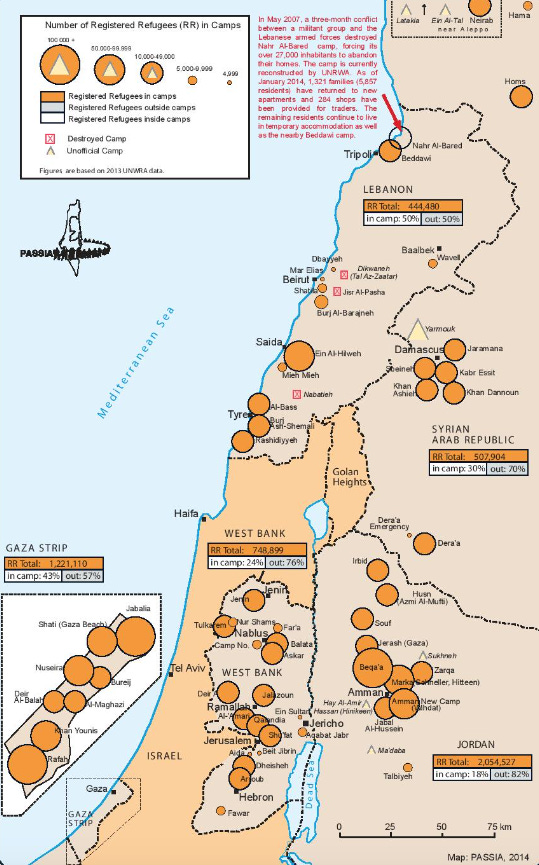
I’ll close with a few thoughts on the instant Israeli demonization of the United Nations Refugee and Work Agency, UNRWA. This UN agency has been a life line for displaced Palestinians not only in Gaza and the West Bank but also in Lebanon, Jordan, and Syria.
Eighteen governments including my government of Canada fell straight in line with withholding funding from UNRWA, the agency carrying the largest burden of the responsibility to provide humanitarian supplies into Gaza at this moment of grave need. To contribute to the holding back of humanitarian aid at this time and in this context may be interpreted as a flirtation with complicity in genocide.
Canada I think is already complicit in genocide because it supplies weapons to the government of Israel. There are also reports that Canada’s special forces unit, Joint Task Force-2, took part with the IDF in military operations in Gaza, As I see it, the complex of Israel Lobby organizations in Canada, but especially the Centre for Israel and Jewish Affairs, CIJA, are also complicit in genocide because they counsel Canada’s people and its government to show contempt for the World Court and the UNRWA.
The CIJA’s actions indicate why the organization should have to register as a lobby for a foreign government and why it should not be treated as a charitable philanthropy capable of issuing receipts for tax exemptions.
All of this resistance to ending the genocide in Gaza causes me to be less optimistic about turning the corner away from the notorious rules-based international order. Many of its protagonists seem to have no problem with aligning themselves with the Israel-US genocide in Gaza as well as with the attackers on Yemen and Lebanon. As I am coming to understand it, however, the weight of worldwide public opinion that is no longer prepared to tolerate the obscenity of open genocide in our midst, is making headway towards a humanitarian approach embracing national sovereignty, multipolarity, and the security that comes from a more robust embrace of the rule of law.