Showing posts with label China. Show all posts

Saturday, September 20, 2025

"Trump’s Destruction of US Economy, Starting with Agriculture" by Michael Hudson


Click here for Exit the Cuckoo's Nest's posting standards and aims.

Source: Naked Capitalism


Michael Hudson: Trump’s Destruction of US Economy, Starting with Agriculture

Yves here. Michael Hudson makes a short but devastating indictment of the destruction Trump policies are inflicting on the agriculture sector. The most visible example is soybeans, which had until Trump tariffs, had had China as their biggest buyer. But other types of farmers, as well as farm suppliers like John Deere, are also in a world of hurt.

In a bit of synchronicity, Nikkei has just published US soybean farmers face crisis as China keeps orders frozen, which add color to Hudson’s account. Key sections:

Trump and Chinese President Xi Jinping are speaking on Friday about a U.S. TikTok operation and other tariff issues. It is unclear whether agricultural purchases and the plight of American soybean farmers will come up. Either way, analysts say the soybean standoff is revealing China’s tactics and priorities while also highlighting U.S. vulnerabilities….

“If it was a hot war, China wants to know that it is possible to get through an extreme situation for food security,” she [Even Pay, director at Trivium China] said. “China also wants to know that it can’t be backed into a corner by a hostile U.S. administration.”

Pay added that China has also been pursuing a long-term plan to diversify sourcing, due to concerns that the country was overly reliant on American soybeans….

Johnny Xiang, founder of Agradar Consulting in Beijing, said that China’s purchasing of Brazilian soybeans this year has been quite “aggressive,” and that it now has a steady supply of soymeal from Argentina and Uruguay as well. “China’s purchases of U.S. soybeans depend entirely on whether the Trump administration removes the tariffs on Chinese goods,” he said.

Chinese buyers historically purchase American soybeans in September, as the Brazilian harvest comes to an end. Experts are mixed about whether China can completely forgo U.S. supplies — which are also subject to 34% Chinese tariffs — this year if a trade deal does not come to pass. Some say China’s current supply will not last until Brazil begins picking new crops in February, but Trivium’s Pay said China’s policy rhetoric could suggest otherwise.

“Someone is going to have to eat some pain,” she said….

The U.S. Department of Agriculture this week made its lowest soybean export forecast since 2013, at 1.65 billion bushels.

In North Dakota, where agriculture makes up over a quarter of the state’s economic output, 90% of soybean production is exported, according to the North Dakota Soybean Council — most of it, under normal circumstances, to the world’s top buyer, China. Unlike states further south and east, such as Illinois, which are better positioned to shift their supply to other markets such as Europe and Mexico, North Dakota’s soybeans are farmed near railroad infrastructure purpose-built for sending harvests to the West Coast and on to China.

Nikkei points out that US soybean farmers went through a similar crunch in Trump 1.0, when a China trade war led to a sharp cut in soybean buys. That Administration made $23 billion in payouts to farmers in 2018 and 2019 to offset the damage.

By Michael Hudson, a research professor of Economics at University of Missouri, Kansas City, and a research associate at the Levy Economics Institute of Bard College. His latest book is The Destiny of Civilizatio

Trump has created a crisis for U.S. agriculture with his Cold War weaponization of foreign trade with China and Russia, for manufacturing as a result of his steel and aluminum tariffs, for consumer price inflation mainly from his tariffs, and for affordable housing with his tax cuts that have kept long-term interest rates high for mortgages, auto and equipment purchases, and deregulation of markets giving a free hand to monopoly pricing.

  1. Trump’s Impoverishment of U.S. Agriculture

Trump has created a perfect storm for U.S. agriculture, first in his Cold War policy that has closed off China as a soybean market against and Russia, second in his tariff policy blocking imports and thus raising prices for farm equipment and other inputs, and third in his inflationary budget deficits that are keeping interest rates high for housing and farm mortgage loans and equipment financing – while keeping farmland prices low.

The most notorious example is soybeans, America’s major farm export to China. Trump’s weaponization of U.S. foreign trade treats exports and imports as tools to deprive foreign countries dependent on access to U.S. markets for their exports, and on U.S.-controlled exports of essential commodities such as food and oil (and most recently, high technology for computer chips and equipment). After Mao’s revolution in 1945, the U.S. imposed sanctions on U.S. grain and other food exports to China, hoping to starve out the new Communist government. Canada broke this food blockade – but it has now become an arm of U.S. NATO foreign policy.

Trump’s weaponizing of foreign trade – keeping open a constant U.S. threat to cut off exports on which other countries have come to depend – has led China to totally stop its advance purchases from this year’s U.S. soybean crop. China understandably seeks to avoid being threatened by a food blockade again, and has imposed 34% tariffs on U.S. soybean imports. The result has been a shift in its imports to Brazil, with zero purchases in the United States so far in 2025. This is traumatic for U.S. farmers, because four decades of soybean exports to China have resulted in half of U.S. soybean production normally being exported to China; in North Dakota the proportion is 70%.[1]

China’s shift in its soybean purchases to Brazil is irreversible, as that country’s farmers have adjusted their planting decisions accordingly. As a member of BRICS, especially under President Lula’s leadership, Brazil promises to be much a more reliable supplier than the United States, whose foreign policy has designated China as an existential enemy. There is little chance of China responding to a U.S. promise to  restore normal trade by shifting its imports away from Brazil, because that would be traumatic for Brazilian agriculture and would make China an unreliable a trade partner.

So the question is, what is to become of the enormous amount of U.S. farmland that has been devoted to soybean production? Unable to find foreign markets to replace China, farmers are reported to suffer a loss on their soybean production, which is piling up in excess of existing crop storage capacity. The result is a threat of farm foreclosures and bankruptcy, which would lower prices for farmland. And as interest rates remain high for long-term loans such as mortgages, this deters small farmers from acquiring troubled properties. The result is to accelerate the concentration of farmland in the hands of large absentee financial funds and the wealthy.

This shift is irreversible. Despite the Supreme Court ruling that Trump’s tariffs are unconstitutional and therefore illegal, it seems likely that Trump could simply have the bipartisan anti-China Congress and Senate impose these tariffs. In any case, Trump’s policy represents a sea change, a quantum leap into U.S. coercive trade aggression.

There is zero chance of U.S. China trade in soybeans or other basic Chinese needs from being revived. Neither it nor other countries threatened by U.S. trade aggression can take the risk of depending on the U.S. market.

 America’s agricultural cost and income squeeze goes far beyond soybean sales. Production costs are also rising as a result of Trump’s tariffs, especially on farm machinery, fertilizer and credit tightness as the risk of farm debt arrears increase.

  1. Trump’s tariffs are raising U.S. industrial costs of production

Trump’s tariff anarchy also is causing losses and layoffs of two thousand employees for John Deere and Company, with a demand also falling for other manufacturers of farm equipment. The most serious problem is that its harvesting equipment, like automobiles and all other machinery, is made out of steel, along with aluminum. Trump has broken the basic logic for tariffs – to promote the competitiveness of high-profit capital-intensive industry (especially for established monopolies), largely by minimizing the cost of raw materials. Steel and aluminum are basic raw materials.

These tariffs have hit John Deere in two ways. For its domestic production, sales are low because of the depression of farm income cited above. Yields have soared this year for corn as well as soybean, leading their prices and farm income to decline. That limits the ability of farmers to buy new machinery.

Deere imports about 25 percent of the components of its products, whose cost of is increased as a result of Trump’s tariffs.[2] Deere’s manufacturing facilities in Germany have been especially hard hit. Trump surprised Deere by ruling that over and above his 15% import tariffs on imports from the EU, he is imposing a 50% tax on the steel and aluminum content of these imports.

That also hits foreign producers of farm equipment, leading to new complaints by EU about Trump’s constant “surprises” in adding to his demand for “givebacks” in exchange for not raising tariffs on imports from the EU even further.

  1. Trump’s Fight to Accelerate Foreign Reliance on Oil and Hence Global Warming

Opposing any alleviation to global warming, Trump has withdrawn from the Paris agreement and has cancelled subsidies for wind power, and also for public transportation. This is the effect of lobbying by the oil industry. Not only is U.S. foreign policy dominated by the demand to control oil as the key to weaponizing foreign trade sanctions, but also U.S. domestic economic policy. Soon after World War II ended, Los Angeles tore up its streetcars, forcing its inhabitants to join the automobile economy. Dwight Eisenhower initiated the interstate highway program to favor auto transportation – and with it the consumption of oil.

Also plaguing U.S. agriculture is a deepening water shortage for crops and destruction caused by flooding, drought and other extreme weather. One cause is the extreme weather resulting from global warming, which Trump denies as part of his policy to support U.S. oil and coal while actively fighting against wind and solar energy production. He has withdrawn U.S. support for the Paris Agreement with other nations to de-carbonize world production.

Insurance costs are rising to unaffordable levels for many areas most prone to storms and flooding, much as the annual cost of housing has soared in Miami and other Florida cities and the southern border states threatened by hurricanes.

 A parallel disruption is the rising electric price as well as a water shortage caused by the rising demand to cool the computers needed for Trump’s support of automatic intelligence and quantum computing. The increasing demand for electricity far beyond the investment plans by power utilities to increase their production. Such planning takes many years – and utilities are happy to see the shortages push demand far above supply, enabling prices for electricity to be one of the major contributors to inflating the cost of production.

Trump and his cabinet have made fun of China for spending so much money on its high-speed train service. Western calculations of economic efficiency leave out the all-important balance-of-payments effects of this rail development: It avoids forcing Chinese to drive cars using imported oil. China has no domestic oil industry to dominate its economic planning or foreign policy. In fact, its foreign policy aims regarding the oil trade are the opposite of those in in the United States.

  1. Trump’s Sanctions to Weaponize U.S. Exports to Its Designated Enemies

Trump’s (and Congress’s threat) to sabotage exports of computer switches with secret “kill switches” to turn them off by U.S. fiat has led China to cancel its planned purchases from Nvidia. The company has warned that without the profits from exports to China, it will be unable to afford the R&D needed to keep competitive and maintain its monopoly on chip manufacturing.

These trade policies slashing U.S. export markets and imports are just one reason why the dollar is weakening. Other causes are declining tourism as a result of U.S. harassment, especially of foreign students from China, on which U.S. universities have depended as the highest-paying students.

These non-trade balance-of-payments trends explain why Trump’s high-tariff policy has not led the dollar’s exchange rate to strengthen despite its effect on discouraging imports. Normally that would increase the trade balance. But Trump’s war against all other countries (mainly his European allies, Japan and Korea) has led to a shift of their dependency on U.S. exports (such as soybean) and products against which they are retaliating in order to protect their own balance of payments, e.g., cutbacks in foreign tourism to the U.S., foreign students, dependency on U.S. arms exports – and most of all, financial capital flight seeing that the shrinking U.S. home market must cut into foreign profits and the dollar’s decline will reduce its valuation in foreign-currency terms.

Also, as BRICS and other countries conduct trade in their own currencies, this reduces their need to hold foreign-exchange reserves in dollars. They are shifting to each others’ currencies, and of course to gold, whose price has just soared over $3,500 an ounce.

  1. Trump’s Sharp Increase in Inflation, from Electricity and Housing to Industrial Products Made Out of Aluminum and Steel, or Subject to Crippling Tariffs on the Supply of Parts and Necessary Inputs

Trump’s decision to impose tariffs on basic inputs, headed by aluminum and steel, are increasing prices for every industrial product made out of these metals.

And of course, his tariffs generally are rising prices across the board as companies have waited a polite month or so before raising prices as their existing inventories of goods produced by China, India and other countries are exhausted.

Trump’s deportation of immigrants has increased the cost of construction, which relied largely on immigrant labor – as did agriculture in California and other states at harvest time. It is not clear who, if anyone, will replace this labor.

Instead of attracting foreign investment as Trump has demanded that Europe and other trade “partners” provide, he has made this market much less desirable. What he has done is provide an object lesson in what other countries need to avoid in creating regulations, tax rules and trade policy to minimize their costs of production and become more competitive.

  1. Monetary Policy Is Sharply Increasing Long-Term Interest Rates, Even if Short-Term Rates Decline

Long-term interest rates determine the cost of mortgages, and thus the affordability of housing. Trump’s inflationary policy also increased interest rates for long-term bonds. The effect is to concentrate borrowing at short-term maturities, concentrating the problems of rolling over debt in times of financial crisis. This impairs the resilience of the economy.

Many consumer goods imports are bought by the ultra-rich – the 10% of the population who are reported to account for 50% of consumer spending, For them, higher prices simply increase the prestige of such conspicuous-consumption status items (including expensive food delicacies).
Friday, August 29, 2025

"Peter Thiel and Vladimir Ilyich Lenin – Apostles of Two Economic Orders (Part 2)" by Hua Bin

]

Click here for Exit the Cuckoo's Nest's posting standards and aims.

Source: Hua's Substack


Peter Thiel and Vladimir Ilyich Lenin – Apostles of Two Economic Orders (Part 2)

Understanding the US and the Chinese economies from historical lens

In the first part of my essay, I outlined how market and competition in the earlier phases of industrial capitalism in the West have given way to monopoly finance capitalism in the pursuit of maximum capitalist profits (a.k.a. shareholder value), as advocated by Peter Thiel, the philosophical godfather of Silicon Valley tech and financial elite that rules over the US political economy today.

Thiel’s own road to riches symbolizes the merger of tech and finance oligarchies. He made his first fortune ($55 million) when he sold PayPal to eBay in 2002. Since then, he leveraged this relatively modest sum into a net worth of around $23 billion by investing in Facebook, LinkedIn, Space X, Palantir, and OpenAI. He is also one of the largest shareholders of Bitmine, a major Bitcoin mining company.

Thiel epitomizes the rise of what Jonathan Levy, a University of Chicago economic historian, calls “asset appreciation capitalism” in his book Ages of American Capitalism.

Asset appreciation capitalism is a form of wealth creation where value is increasingly generated and accumulated through the rising value of assets, such as land and financial instruments, rather than through production of goods.

As the US moved from an industrial-focused capitalism to one where financial markets become central to wealth creation and distribution, “getting rich” is all about making owned assets more valuable, rather than about creating new wealth through labor or production.

The wealth growth of the owner class far outpaces the income growth of workers, even highly skilled and highly paid professionals. The end result is an extreme concentration (or monopoly) of wealth and power as well as extreme inequality.

Vladimir Lenin, the founder of the Soviet Union and a sharp critique of predatory financial capitalism, accurately predicted that such monopolistic capitalism would evolve into a highly financialized and parasitic form of imperialism that would pursue world hegemony.

Lenin’s dialectical materialism-based analysis perfectly illustrates the foundational struggle between the US and China that defines the changing world order today.

In contrast to the US, being a student of Lenin’s political economy, China has chosen a completely different path under President Xi Jinping – the socialist market economy.

From the start of his time in office, President Xi has focused on growing the “real economy” (especially manufacturing), promoting competition, and clamping down on tech and real estate oligarchs. The aim of such policies is to prevent China from becoming another hollowed-out financialized rentier economy.

China has firmly adhered to retaining credit and monetary policies in the hands of the state, instead of being captured by private financial interests like the Federal Reserve in the US.

Although China’s model is informed by Lenin’s warning on finance capitalism, it has evolved from the central planning model of the USSR.

China’s current political economy is a combination of Hamiltonian economic programs and unique innovations based on its own historical tradition, including decentralized local execution under top-down strategic guidance, meritocratic performance management of government officials, and hyper competitive private sector.

An example of this economic innovation is what economist Jin Keyu called “the Mayor Economy” in her book The New China Playbook, which describes how local cities are empowered to foster and grow local champions in key strategic sectors. The China model today is often called “beyond capitalism or socialism”.

I characterize this form of political economy as market-based state industrial capitalism. If interested, you can refer to my essay The Secret Sauce of Chinese Industrial Success (https://huabinoliver.substack.com/p/the-secret-sauce-of-chinese-industrial )

The result of such divergent economic choices is that China is becoming the Economy of Abundance as competition blooms while the US becomes an Economy of Scarcity as monopolies extract parasitic profits.

The signs are all over the place -

Chinese overcapacity
The much decried “China overcapacity” is in fact a sign of full market competition, a sign of abundance.

Maybe from the purest return on investment perspective, many Chinese industries have overbuilt and failed to deliver high returns in the short term. But another perspective is China builds for future demand. In contrast, companies in the west build for existing demand with little buffer for resilience.

One example is electricity generation capacity. Beijing has invested heavily over 4 decades to develop both traditional and green energies from solar, wind, hydro to nuclear power. As a result, China produces more electricity today than the US, Europe, Japan and India combined.

China’s annual electricity demand growth equals to the entire country of Germany, but China builds 2 Germany’s worth of new generation capacity each year.

China is better positioned than any other country to meet the growing demand for electricity from large-scale AI rollout, with the world’s largest and fastest growing green and nuclear energy generation capacity and the biggest ultra-high voltage grid network.

Within the electricity generation supply chain, capacitors play a fundamental role for storing electrical energy and stabilizing supply fluctuations. China holds a dominant position in the overall global capacitor market, with a global market share of 50%. US has a negligible share in this critical component market, representing one more hurdle in expanding its power generation.

The National Energy Agency reported that China’s electricity consumption surpassed the 1 trillion kilowatt-hour mark in July 2025, as scorching heatwaves pushed up demand.

This represents an 8.6% growth from a year ago and equivalent to the whole-year electricity consumption of ASEAN countries. No other country can meet such dramatic increase in demand without overloading its grid system.

China’s “overcapacity” makes sure the country can address demand volatility with ease.

Here is an opposite example of western capacity woes – according to Mark Rutte, head of NATO, the whole NATO alliance cannot match, in a year, the ammunition production of Russia in 3 months despite having a collective GDP 25 times larger than Russia.

According to the Guardian, the US and Israel used up 25% of the entire US THAAD interceptor stockpile in the 12-day war against Iran. Iran fired 400 to 500 missiles during the time, many from its old stockpiles. Israel had to sue for peace as the Zionist state was on the verge of depleting its air defense.

Pentagon admits it has only one quarter of the Patriot air defense interceptors it needs for all its war plans. Therefore, it had to ration these interceptors between Ukraine and Israel.

If Iran can exhaust US/Israel air defense in less than 2 weeks with its limited defense production base after decades of economic sanctions, how could the US and its vassals sustain a high-end conflict with China when China can fire 2,000 missile salvos a day in the beginning month of a Taiwan war, as per a Rand Corporation war game.

The US Navy openly admitted China has 240 times US ship building capacity. And in a war of attrition, China can mobilize a wartime production capacity an order of magnitude bigger than the US.

In a war scenario, US war planners would be overjoyed if they had an “overcapacity” issue.

Artificial Intelligence buildout

The global battle for AI dominance is happening between US and Chinese tech companies. US firms have significant compute advantage from the chip ban while Chinese firms focus on software optimization and efficient use of limited compute resources.

They have also pursued divergent product and market strategies. AI leaders in the US – OpenAI, Google Gemini, xAI (Grok), Anthropic Claude – are all focused on high-priced proprietary closed systems to maximize revenue from their LLMs and generate high return on the massive investment they have made.

Market fully expects these firms to monopolize the global AI market and has rewarded them with astronomical valuations. For example, OpenAI is valued at $500 billion despite having a revenue of just $5.5 billion in 2024 and an operating loss of billions. OpenAI’s CFO admitted the company won’t turn a profit until it hits $125 billion in revenue.

In comparison, Alibaba, the ecommerce and AI leader in China, has a market capitalization of $280 billion, just half of OpenAI. However, Alibaba generated revenue of $130 billion in 2024, more than 20 times of OpenAI, with a net income of $11 billion.

Chinese AI leaders have chosen an “open source and open weight” strategy, the opposite of the US proprietary closed system. Their goal is to provide users and developers everywhere with full access to their free frontier models.

The most prominent Chinese AI models are all open source and open weight – DeepSeek R1, Moonshot AI Kimi K2, Alibaba Qwen3, Z.ai GLM4.5, and MiniMax M1.

By open-sourcing their LLMs, these AI startups strive to expand AI usage and applications more broadly to users who want cost-effective, transparent, and controllable AI models that fit their needs and protect their own proprietary data and trade secrets.

Chinese AI industry has prioritized broad access and adoption over short-term profits. Their long-term strategy is to monetize their investment through application support and customized services rather than charging for usage/inference.

Instead of creating a bottleneck around frontier AI models, Chinese AI players want to turn large foundational models into a commodity and recoup their investment mainly through value-added applications and innovations built atop these models.

While the American AI companies’ goal is to corner the market and develop dependencies, the Chinese AI companies plan to democratize access and make possible true digital sovereignty.

The result has been immediate and overwhelming – since DeepSeek’s launch in January 2025, numerous high performing Chines AI models have rolled out, all with “open-source, open-weight”. Their performances are close to parity and sometimes overtake the leading proprietary models in benchmarking tests.

According to Martin Casado, a general partner at Silicon Valley-based venture capital firm a16z (formerly known as Andreessen Horowitz), Chinese open-source frontier models are used by 80% of AI startups looking for funding at his firm.

Casado and many industry insiders like Ali Farhadi at the Allen Institute for AI are predicting that China will most likely lead the coming wave of broad-based AI applications.

The housing crisis and inflation

Both China and the US are having a housing crisis as we speak. China’s well-known housing crisis is one of too much supply, leading to a lower price; the lesser-known US crisis is one of not enough supply, leading to higher rents and higher house prices.

While falling housing prices in China have reduced wealth and dampened consumption, affordability has vastly improved. On the other hand, financial capitalists such as Blackstone have cornered the US residential markets. Average US household spends more than 30% disposable income on rents or mortgage payments, according to Pew Research Center.

Inflation as measured by CPI is next to zero in China, for years now. Chinese consumers didn’t experience rising prices even during the worst Covid period. Housing and most physical goods are cheaper now than 5 years ago. In contrast, inflation seems firmly entrenched in the West, especially in the Anglo sphere.

Even when measured by the highly dishonest “core CPI” metric, the US inflation was running at 3.1% in July 2025. True inflation, or “pocketbook inflation”, is much higher.

The “official” inflation data seen in the financial media typically refers to “core CPI”. The calculation conveniently excludes food, energy, transportation, and housing, ostensibly to strip out volatility but in effect understating true inflation for the most important needs that are felt at pocketbook level.

Market competition

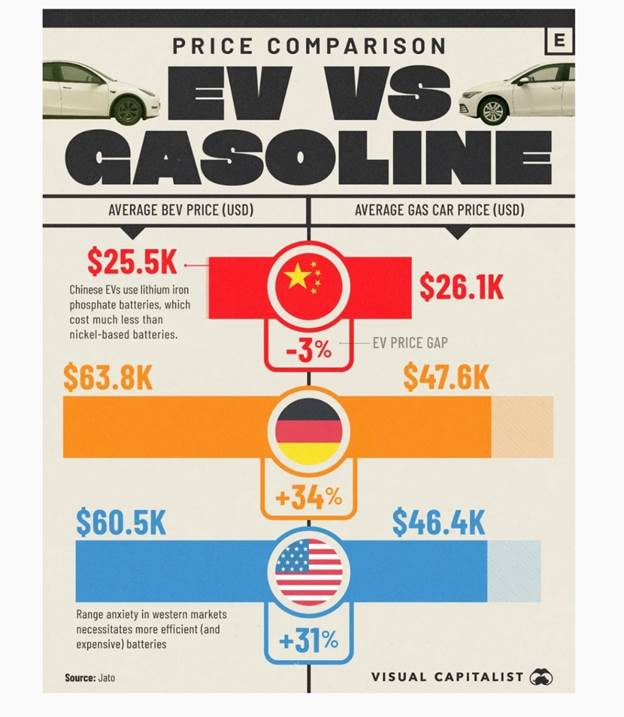
From automobiles to restaurants, the much higher level of abundance in China has led to intense competition in the marketplace. Such competition has led to lower prices and higher consumer surplus.

Business profits are indeed lower but, as Peter Thiel correctly pointed out, perfect competition should lead to lower profits for the capitalists. If this is the definition of free market, then why not let the market work its magic?

The much lower level of competition in the US has led to lower capacity, higher scarcity, and persistent inflation for consumers from food, rent, education, to healthcare.

A quick look at most industries, you’ll find the intensity of competition is much higher in China than the US.

- For smart phone, Huawei, Xiaomi, Oppo, Vivo, and Honor compete against Apple and Samsung

- For EVs, BYD, Geely, Cherry, Nio, Li Motors, MG, Xiaomi, and Aito compete with Tesla and VW

- There are over 60 airlines operating in China and the biggest 3 have a collective market share under 40%. While in the US, the Big Four controls 75% market share

- There are 150 active shipyards in China while 2 are producing new ships in the US as of early 2025, according to Gemini

While businesses, especially monopolies, enjoy ever higher profits and therefore higher stock prices and market caps, the wealth distribution is highly uneven with the capitalist class taking the lion’s share of prosperity (under the euphemism of “shareholders”).

A poster of a price comparison of gasoline and cars

AI-generated content may be incorrect.

The competition is extending beyond businesses and is intensifying between Chinese cities, as local governments push to develop high tech hubs and attract talents:

- Hangzhou and Shenzhen are competing against each other in AI and robotics

- Chongqing and Hefei in EV

- Suzhou and Chengdu in biopharmaceuticals

- Guizhou and Guangxi in data centers

- Shanghai and Dalian in ship building

- Chengdu, Shenyang and Xi’an in aerospace, military jets and drones

Each local government is offering incentives and infrastructure to help businesses build production hubs, R&D centers, and localized supply ecosystems. Success not only transforms local economy but also plays a critical role in local officials’ performance evaluation and promotion.

The Mayor of Hefei has gained national spotlight and is widely rumored to be on the fast track to national leadership as the city was transformed from a backwater to a hustling hub of high-tech industries from EV, photovoltaics, semiconductors, LCDs, and quantum technology in the last 10 years, driven by the Hefei Nationl High-tech Industry Development Zone.

Fixed asset and infrastructure investment

Another sign of the Economy of Abundance in China is in the area of fixed asset capital investment. Over the decades, China has invested trillions to create incremental new capacity, from factories, roads, high speed rail, ports, power grids, to telecom infrastructure.

Out of the 60,000-kilometer total highspeed rail worldwide, 48,000 kilometers were built in China since 2008. China plans to expand its domestic highspeed rail network to 60,000 kilometers by 2030, recently starting the Xijiang-Tibet high speed rail construction.

18 of the top 20 tallest bridges in the world are in China. 7 of the top 10 container ports are in China. The top US container port – the Port of Los Angeles and Long Beach – ranks 17th, behind Dalian in north China. 4 of the top 10 hydro dams are in China.

In 2024, China accounted for 70% total world EV production, 80% generic key starting materials (KSMs) and active pharmaceutical ingredients (APIs), 80% solar panels, 77% batteries, over 50% steel and cement, and 90% refined rare earth.

According to World Bank, by 2024, China accounted for 36% global manufacturing output, compared with 12% for the US. China’s share of global manufacturing is bigger than US, EU, and Japan combined.

Most Chinese capital investments are financed by state-owned banks. The banks channel the high savings of the population to productive industries under the guidance from both the market and the government.

While there are certainly overreaches, like the blind overinvestment in real estate in the 2000s, most resource allocations are rational and productive, as with the decade-long Made in China 2025 initiative that focused on high-tech manufacturing and delivered amazing results.

Such investment had led to massive productivity gains and has put China on the leading edge of future technological innovations.

Beijing has also learned that the market is not infallible as we have seen with the speculative housing bubble. Government intervention is needed to achieve the right balance.

On the other hand, capital investment in the US and, more broadly, the West has stalled, except for the ongoing AI craze with massive data center and related power generation buildout (which is most likely another bubble to burst soon if the underwhelming launch of ChatGPT 5 is anything to judge by).

Capital investment is mostly in existing capacity and serves mainly to facilitate transfer of ownership such as M&A, share buybacks, or privatization of public utilities. Little incremental productive capacity is built.

Despite the “Rebuild America’s Infrastructure” pledge made by every US administration since George W Bush, and “Infrastructure Week” almost every week in Trump 1.0, little actual investment has gone into rebuilding the country’s run-down highways, rails, ports, bridges and power grids.

The American Society of Civil Engineers (ASCE) estimated nearly 77,800 bridges nationwide were structurally deficient in 2023.

When Apple announced its giant $600 billion-dollar domestic investment, I decided to dig into what projects Apple is funding. The only concrete programs are 1) a manufacturing academy in Detroit; 2) a new AI server factory in Houston; and 3) sourcing US-made rare earth from MP Materials.

The manufacturing academy and rare earth sourcing are hardly big-ticket capex projects. And I doubt an AI server factory, however grandiose, will be a multi-billion affair. The most advanced semiconductor foundry built by TSMC, probably the most expensive manufacturing project possible, costs around $20 billion.

Unless Tim Cook plans to build 30 state-of-the-art 3nm foundries, it is hard to imagine these paltry projects Apple has specified would add up to $600 billion. By the way, I checked, there will be no iPhone to be made in the US, or Mac Air for that matter.

If Cook is not lying, how could Apple invest such an astronomical amount of money? A quick search on Google Gemini gives the answer away – “Apple has spent over $945 billion on share buybacks since 2012, with its most recent major buyback program authorized in May 2024 for $110 billion. This includes a record-breaking $81.8 billion in buybacks during the 12 months ending March 31, 2024, and a figure of $697.7 billion over the preceding decade ending in June 2025.”

I assume Tim Cook would be doing a few more hundred billion dollars’ worth of share buybacks to meet the commitment to Trump in his contribution to “make America great again”.

Similarly, when large businesses in the US announce their investments, few are greenfield new capacity. More often than not, such investments are transfer-of-ownership transactions such as share buybacks, leveraged buyouts, or privatization deals. The only problem is share buybacks don’t create jobs or translate in productive capacities.

De-myth the role of foreign direct investment (FDI) in China

One common misconception in the West about China’s development is that its growth is the product of massive foreign direct investment (FDI) from western countries, especially the US. If you listen to US politicians, you get the feeling that China’s development is gifted by American companies moving factories there.

While trade and FDI have indeed played a critical role in early stage of Chinese economic takeoff, FDI has never been the main driver of China’s investment in industrial capacity and infrastructure.

FDI from the US accounts for under 15% of the total FDI flow into China, well behind Hong Kong and Singapore.

Grok estimates total FDI in China during the last 40 years is $3.66 trillion. The total cumulative US direct investment in China stands at $500 billion (compare that with China’s holding of US Treasury notes of $750 billion, which is China’s investment in the US).

To put the numbers in context, the cumulative GDP for China in the last 40 years is $208 trillion. And cumulative fixed asset investment (or capital formation) in the same period is $89.5 trillion.

FDI represents about 4% of the capital formation in the last 40 years and FDI from the US represents 0.55%.

FDI as % of China’s GDP is lower than BRICS average and lower than most EU countries. It is closer to the US. According to Grok’s analysis, both China and US have lower trade and FDI dependency than other major economies, both having a more domestically driven economy.

Rather than FDI, Chinese domestic savings is the real engine that has powered the country’s investment and growth. In other words, the “under consumption” of the Chinese has provided for the capital formation.

The role of banks

In economic textbooks, banks are traditionally the source of funds for business investment. Indeed, state-owned banks are responsible for financing the bulk of China’s fixed assets investment and infrastructure buildup. Banks channel domestic savings to incremental productive opportunities.

However, as Professor Michael Hudson argued, banks in the West today lend only against collaterals, i.e. existing assets. They are no longer in the business of lending for high-risk incremental capacity.

One analysis shows that more than 85% of US business investments in factories and inventory come from retained earnings or new stock issuance.

Banks in the West prefer to lend to real estate or M&A of existing businesses that can create rent-seeking opportunities. As mentioned earlier, private equity vultures leverage bank financing to buy up low-income residential units, trailer parks, public utilities, securitized student loans, nursing homes, and even prisons for maximum extraction.

There is little incremental investment to increase service capacity or quality with most multi-billion dollar PE deals. The financiers are simply loading up debt and moving assets from one set of owners to another, enriching themselves in the process.

The most lucrative deals are bottlenecks or toll road-like investments where financiers can establish a rent-seeking business model, ideally with a captive customer base like students, prison inmates, or the elderly. For case studies of such vulture finance capitalism, Plunder: Private Equity's Plan to Pillage America by Brendan Ballou is an excellent reference.

If one can describe China’s investment in productive capacity, R&D, and infrastructure is to debottleneck the economy and create abundance, finance capitalists in the West are doing the opposite as scarcity is the best way to ensure the highest return.

Quite literally, the finance capitalists are the modern-day reverse Robin Hood.

Such financialized economy today is no longer the capitalism described by Adam Smith. Wealth creation is through transfer of ownership, not from more productive risk-taking entrepreneurship.

Financialization is largely responsible for killing US manufacturing as it is based on money-making for the benefit of shareholders whose interest is only their return on investment, irrespective of the well-being of the workers or the nation.

The result is in plain sight – the US economy is increasingly a rentier Economy of Scarcity, with the associated costs borne by consumers.

In conclusion, China’s success in the past few decades is a result of a deliberate policy choice to build a production economy and deliver broad-based common prosperity. Its economic model is market-based state capitalism with high levels of government involvement in strategic guidance and resource allocation.

This is a mixed model incorporating many elements of the Hamiltonian economic programs, which were responsible for economic takeoff of the US in the late 19th century, and elements of socialism inspired by the USSR. There is also a heavy dose of meritocratic governance based on long time Chinese traditions.

Of course, no models for political economy are static and univeral. The China Model will continue to evolve, hopefully towards a more socialist model where equitable distribution is coupled with more wealth creation.

The ultimate contribution of the China Model is that China has shown the world an alternative – it is possible to modernize without wholesale westernization, and prosperity doesn’t only come from the financial capitalism practiced in the West.

Disqus