Showing posts with label Europe. Show all posts

Saturday, February 17, 2024

"An Anti-Russian Europe Is a Europe That Destroys Itself!" by Hugo Dionisio


Click here for Exit the Cuckoo's Nest's posting standards and aims. 

Hugo Dionísio
    February 16, 2024

This European Union is demonizing the country that saved it from Nazi-fascist terror by rewriting its past, desecrating its dead, misrepresenting its thinking and conspiring with its achievements.

❗️Join us on TelegramTwitter , and VK.

Contact us: info@strategic-culture.su

According to Syrsky, the new commander-in-chief of Kiev’s troops, the lives of Ukrainian soldiers are the most important thing the army has. An assumption that was only made when it became obvious to everyone that there was no chance of victory in a direct fight against Russia.

As long as it was possible to feed the idea that „Ukraine was beating Russia“, when it was Russia that had the initiative — and never lost it — the lives of Ukrainian soldiers were worth little. Men — and some women — in their hundreds of thousands were thrown into muddy trenches, poorly fed and with ammunition in short supply, against an opponent who never lacked anything.

The fact is that when the Kiev forces had combat capability — not to be confused with „the ability to win“ — the official communication was that „Ukraine was winning the war“; when it became clear that the cost of fighting the Russian forces was so high that it could not be sustained, the pro-Kiev media, financed by Uncle Sam’s NGOs and primary sources of Western official information, began to say „Ukraine cannot lose the war“; when it could no longer be hidden that the „counter-offensive“ had failed and with it, the hopes — fanciful — of a Kiev victory, we moved on to the „Ukraine and Russia are in a stalemate“ phase.

The Ukrainian reality, under the Kiev regime, is characterized by always being in direct contradiction with the Russian reality and, coincidentally, with the concrete observable reality. This is why the relationship between the two realities is an invaluable dialectical example from a pedagogical point of view.

While living with Russia, Ukraine has become one of the world’s greatest powers. There is not, and never has been, a successful Ukraine without Russia on its side. Vladimir Putin did not lie about the fact that Russia has always helped Ukraine. For those who don’t know, it wasn’t out of any kind of adventurism that the Donbass was annexed to the Ukrainian Soviet Socialist Republic. In 1917, Ukraine was an eminently rural and de-industrialized region of the Russian empire, so, in 1918, in order to guarantee conditions for the territory’s development and, in this way, a more harmonious development of the nascent Soviet state, the Donbass became part of the Ukrainian Socialist Republic, as a way of guaranteeing the progress of the newly formed homeland.

The truth is that, in 1991, Ukraine had more than 50 million inhabitants, one of the largest armies in Europe (perhaps the second largest), an enviable military-industrial complex, a highly qualified, talented and productive population, capable of revealing itself in all aspects of human life, from the arts to science, from agriculture to sport.

After surviving many tensions imposed from outside and introduced by the usual suspects, in 2004-2005, the Orange Revolution accelerated the process of creating an anti-Russia. The idea was not new and had already crossed the minds of people linked to the Austro-Hungarian Empire and beyond. From then on, the balance of power between the Russian-speaking and Russian-sympathetic peoples and the peoples who had become „Russian-phobic“ began to reverse and, gradually, the anti-Russian forces began to infect the entire territory, gradually conquering new strongholds, from the outskirts of Galicia to the center of Kiev.

From then on, what would be the imported „solution“ to fill Ukraine’s lack of national identity began to take shape. As a country that had never existed until 1918, and only became fully independent in 1991, Ukraine had to create a national identity in order to guarantee its existence. Not an easy thing to do in a country built up by ruler and square in successive waves of annexation. The induced „choice“ was to turn Ukraine into an „anti-Russia“. Everything Russia would be, Ukraine would have to be the opposite.

It’s clear to see that this „choice“ would have to be induced, since in the case of a country with the same language, or languages with the same root (for those who separate „Ukrainian“ from „Russian“), with the same religion, culture and national past, the natural choice would never be antagonism, since one and the other thrived on a symbiotic relationship. And this relationship was mutually fruitful right up until the moment when Russia did everything it could to free itself from US domination in the terrible 1990s, and Ukraine did everything it could to integrate itself under US control, mainly from 2004 onwards. The chronological succession leaves no doubt: Russia freed itself from American tutelage during the late 90s and early 2000s, Ukraine embraced it from 2004 onwards.

Once this antagonism was introduced through the installation of a US client regime, first unconstitutionally (with the Orange Revolution) and then through a coup (with EuroMaidan), everything that Russia is and strives to be, Ukraine began not to want to be, even if it had to tear its own flesh to do so. Its national identity has come to be defined by direct and frontal antagonism towards its Russian neighbor. If Russia is a country proud of its history and past, then Ukraine will disregard, erase, rewrite and persecute all those who honor its history. This is clearly visible in the so-called „decommunization“, which could ultimately only lead to the extinction of the Ukrainian nation. Having been created by the Bolsheviks, removing the „communist“ identity from the Ukrainian past would mean — and has meant — ending Ukraine as it was: multi-ethnic, cosmopolitan, even multinational (it has many citizens with dual Russian, Hungarian or Romanian nationality). If Russia embraces its history in order to exist as it is, Ukraine, led by the Kiev regime, erases its history in order to deny what it truly was.

If the Russian Federation is a multi-ethnic, multi-national country, proud of this diversity and considering it an advantage; the Kiev regime would turn Ukraine into a „purified“ country, with a supremacist constitution, persecuting peoples who insist on keeping their original languages, religion and customs. The result was a persecution of all political forces on the left and center-left, perceived as pro-Russian (how convenient!!), the Russian Orthodox religion, the Russian language and the historical past, under the Russian empire and the USSR. The only one it had! Everything linking Ukraine to Russia would simply have to disappear. How can we not see that such an erasure could only lead to the loss of part of the territory? To begin with? Can any country survive intact to such an antagonism? A country without history, what future can it have?

If Russia was neither NATO nor EU — not because it didn’t want to be — Ukraine would have to be very NATO and even more EU. If all Russia wanted was to be at peace with its neighbors, so that business could continue to flow east and west; Ukraine, the one than born from the bowels of Galicia, would have to be at war with Russia. And being at war with Russia began by meaning „war with the Russian-speaking and Russian-sympathetic peoples“. In other words, between Russian speakers and those sympathetic or tolerant of Russia’s historical presence, Ukraine, as a client of the West, entered into an intestinal war with its own entrails, breaking into pieces. It couldn’t have been otherwise.

In view of the disproportionate forces, be they physical forces, such as population, military, industrial or economic capacity, or more spiritual forces, linked to historical identity and the depth of the patriotic and national soul (Ukraine is giving up what little it had), it was easy to see where this antagonism was leading. If Russia was the „being“; Ukraine, led by the Kiev regime, became the „antithesis“; and what possible „synthesis“ could there be? Had the people of Ukraine, those who have embarked on this historical revisionism of their nation, known that „syntheses“, resulting from dialectical antagonisms, often result in the elimination of one of the opposing forces, would they have willingly accepted such a process? And would they have accepted it? If they had accepted it, I say, neither Zelensky would have lied when he promised peace, nor would the US have needed to hide the fact that they boycotted the Minsk agreements and the Istanbul agreement, nor would Zelensky now have postponed the presidential elections. As a result, even in essence, this anti-Russian choice is antagonistic and contradictory.


Only someone completely alienated by the promises of Fukuyama and his „end of history“ could consider a „synthesis“ that would result in the elimination of Russia. Only those who don’t know Russian and European history, and its identity and patriotic aspects, could consider that the role of anti-Russian antagonism that Kiev represents would have the strength to eliminate what is one of the three best-armed countries in the world.

But anyone who thinks that anti-Russian antagonism can only lead to the physical elimination of Ukraine, even if only partially, is mistaken. The European Union-Russia relationship also suffers from the same evils and destructive potential. In this sense, we can even speak of Ukraine as an alter-ego of the European Union.

It was in peace with the USSR — first — and Russia — later — that the European Union was born, grew and prospered. Without that peace, the European Union would never have been able to produce the economic resources to expand, even more so at the expense of paying „structural funds“ to candidate and newly acceding countries.

A European Union at war with Russia, even a cold war, would lead to an existence marked by militarism, tension, closure and a loss of elasticity in terms of democracy and individual or collective freedom. The result would have been a European Union in upheaval, with no welfare state to feed a „middle“ class that could sustain the powerful internal markets on which its industrial potential was built.

This is what German leaders (and others) saw when they created the Druzba (friendship) pipeline and when they later built the Yamal. The flourishing of Europe’s economies was done, in substantial part, at the expense of gas, oil, uranium, fuels, lubricants, minerals and cereals, in quantity and quality, at convenient prices, the result of long-term agreements. Without this „vital food“ there would have been no Franco-German axis to produce the resources needed for the „cohesion policy“ and „European enlargement“. It is interesting to note that this growth was produced in a situation where the Baltic countries — also rich and developed — maintained a neutral position with the USSR and, later, with Russia. This position has recently been replaced by outright antagonism.

Thus, we can also say that, while the relationship was symbiotic, everyone benefited, perhaps even to the detriment of Russia itself, which was always left a little behind, „clinging“ to an export economy of low value-added products, losing the Soviet space first and its economy later, from which it would recover from the beginning of this century.

And it was perhaps this just desire to assume its historical identity that produced, on the European side — and especially on the American side — the antagonism we know today. If the Cold War began with the USSR demonstrating its defense, industrial and technological capacity in the face of a West covetous of its territory and resources, the anti-Russian antagonism was recreated in Western Europe from the moment when the country governed with authority and unquestionable command by Vladimir Putin began to show the capacity to recover its full historical dimension.

Once again, the antagonistic forces are so opposed that they could only produce what we are seeing today. On the one hand, once again, a country proud of its history, a people that celebrates its heroes, in all their faults and virtues; on the other, a European Union that feeds off the sovereignty and the extinction of the patriotic soul of the European peoples. On the one side, a country that wants to be sovereign, independent, autonomous and self-sufficient, so that it can better decide its future without external interference — which is a historical lesson; on the other, a European Union dependent on the USA, which tries to copy the superficial neoliberal „culture“ of consumerism, which celebrates the „end of history“ and strengthens its identity by suppressing the cultural, ethnic and moral identity of the European peoples.

If Russia is proud of its history and celebrates it at every opportunity; just like Ukraine, the European Union is rewriting its own history, its philosophy, its identity. This European Union is demonizing the country that saved it from Nazi-fascist terror by rewriting its past, desecrating its dead, misrepresenting its thinking and conspiring with its achievements. Accordingly, the EU puts in its place a belief that the USSR also started the Second World War and that communism is the same as Nazism. And the most serious thing is that they teach such nonsense in universities… It reminds me of the time when at the University of Salamanca (the oldest in the Iberian Peninsula), it was taught that the world was a plate with antipodes and that it was therefore impossible to travel below the equator.

This rewriting of history also contradicts a Russia that, despite being capitalist, claims to be anti-Nazi and anti-fascist. The EU, on the other hand, is seeing neo-fascist parties flourish in its midst, fueled precisely by anti-Russian antagonism, fed by the economic difficulties resulting from estrangement and the historical revanchism that blames Russia for being what it is and for having lost more than twenty million of its children as a result. At the same time, this EU coexists with and motivates support for a supremacist regime, supported by neo-Nazi gangs, in Kiev and to which it opens its borders, against the will of its people. Today, Polish farmers are threatening to close all border points with Ukraine. The anti-Russian EU is also a Europe at war with itself.

Like Ukraine, the EU also failed to realize its strengths and weaknesses. The EU also failed to realize that it only exists because of Russia. First, against „Russia“ (i.e. the USSR), as an anti-socialist political-ideological project; then, through a symbiotic relationship, enjoying the stability resulting from the power stalemate that the Cold War meant; later, reaping the rewards brought by the winds of Russia’s rapprochement with the West. As an anti-Russia space, the European Union fails to grasp the essentials. The fact is that, as with Ukraine, the way in which the antagonism is resolved, the synthesis that will result from it, will almost certainly end in its own demise. At least, as it is today. Which will still be epic!

A European Union that — as a neoliberal globalist project — disregards national sovereignty, defeated precisely by the antagonistic relationship it develops against a country that, above all, strives to defend its national sovereignty! And NATO beware… It too shares the same identity with the EU, the same original sin! Both are children of the same father, the USA, which is eager to rape mother Russia!

Is there anything more prescient and dialectical than this?

Monday, November 6, 2023

"Europe in the Crossfire: Can All Crises Be Managed Simultaneously?" by Erkin Oncan


Click here for Exit the Cuckoo's Nest's posting standards and aims. 

Click here to sign the People's Proclamation and send it to everyone you know.


Source: Strategic Culture Foundation

Europe in the Crossfire: Can All Crises Be Managed Simultaneously?

Erkin Oncan
    November 5, 2023

Nations advocating multipolarity, stability, and security face threats of military encirclement, coups, and color revolutions, Erkin Öncan writes.

❗️Join us on TelegramTwitter , and VK.

Contact us: info@strategic-culture.su

Russia’s military operation in Ukraine has not only triggered anti-Russian sanctions and financial/military aid for Ukraine but has also exposed the multiple threats confronting Europe. As the West, led by the United States, seeks to wield Ukraine, a product of color revolutions, as a strategic lever, Europe bears the brunt of the ensuing political and economic tensions.

Presently, Europe grapples with escalating energy prices stemming from the Ukrainian crisis and anti-Russian sanctions. Additionally, unrest fueled by Ukraine’s grain restrictions on European countries, a deteriorating economy, the ongoing migration wave, and the challenges it presents continue to be pressing issues awaiting resolution. Meanwhile, Israel’s actions in Gaza and the U.S.’s supportive declarations further complicate matters for Europe.

Despite hopes that a resolution in the Israel-Palestine conflict might shift Ukraine from the forefront, European leaders are expected to navigate both crises simultaneously, with few exceptions like Spain. Quoting Belgian Prime Minister Alexander De Croo, who remarked, “It is evident that the Middle East conflict casts a shadow on events in Ukraine,” Politico anticipates that EU leaders will assert their capacity to address both the conflicts in Ukraine and the Middle East concurrently.

It’s not limited to just Ukraine and Israel; there are also revealed color revolution plans in Kosovo-Serbia, ongoing issues in Georgia, an anticipated political crisis in Armenia due to Azerbaijan’s actions in Karabakh, and political pressure on opposition parties in Moldova, among other concerns.

It’s evident that all of these matters are interconnected with unresolved crises in the former USSR region, and they are, in a broader context, part of the United States’ strategy to encircle Russia.

Meanwhile, Europe is directly grappling with the consequences of these developments, which align with the broader interests of the United States on the global stage, all while striving to enhance its own geopolitical influence.

What is the practical value of these developments? At the recent EU Leaders Summit, German Chancellor Olaf Scholz expressed his satisfaction with the unified stance of EU member states on the Israel-Palestine conflict.

However, Ukraine’s allies in the Baltic region have a different perspective, considering the Israel conflict a distraction. Lithuanian Foreign Minister Gabrielius Landsbergis emphasized that, from their viewpoint, Ukraine takes precedence as the paramount conflict, given its proximity to their borders.

The aftermath of the conflict has revealed a lack of consensus within Europe, contrary to Scholz’s statement. Reports indicate that EU development aid to the Palestinians was unilaterally suspended initially, but later, it was announced that the aid would be subject to examination rather than suspension.

President von der Leyen’s visit to Israel received criticism from the European public, with some perceiving it as one-sided. James Moran of the Center for European Policy Studies explained the internal disagreements as stemming from the confusion that has prevailed over the past few weeks.

The lack of consensus was evident even in the choice of terminology, with no agreement reached on the word “ceasefire” during the EU leaders’ summit. While some countries, notably Spain, used the term “ceasefire,” Germany preferred phrases like “humanitarian pause.”

According to Politico, Berlin aims to avoid appearing to restrict Israel’s right to self-defense due to the historical legacy of the Second World War. However, this raises questions about the extent to which this legacy obscures Israel’s human rights violations in Palestine.

Hamas’ Palestinian resistance, taking a new turn with the Al-Aqsa events, poses a significant threat to U.S. interests, akin to the Ukraine crisis. Furthermore, this operation has put Israel’s normalization efforts with the Arab world, particularly Saudi Arabia, on hold.

In this political climate, European leaders seem to base their position on saving the day when the United States is the most concerned party in the region. Even issues that might seem straightforward, such as “stopping attacks against civilians” and “providing humanitarian aid to the region,” can become complex matters in the eyes of the United Nations.

Several factors contribute to European leaders maintaining a relatively muted stance on Israel. While “anti-Russian unity” surged following Russia’s Ukraine operation, concerns persist regarding shouldering the burden of a second conflict in Europe and the heightened threat of attacks on European borders due to intense immigration.

These concerns are compounded by large-scale protests organized in European capitals in the initial days of the conflict. When combined with the heightened risk of social unrest stemming from the economic crisis related to the Ukraine situation, Europe faces the potential for significant political upheavals, a prospect that worries European leaders.

Additionally, Ukraine’s situation is far from optimal. Luigi Scazzieri from the Center for European Reform, speaking to Politico, highlighted the challenge of managing both conflicts. He noted, “The EU will need to split its attention and financial resources between Ukraine and Gaza. Ukraine may receive less focus, making it difficult for the EU to agree on substantial macroeconomic and military aid for Kiev.

An EU official, who preferred to remain anonymous, expressed concern, stating, “This is an open conflict that impacts European society as a whole and incites unrest in numerous European cities.”

It is evident that the anticipated protests in European cities, referred to as “unrest,” are closely associated with the growing Muslim community and immigrant population in Europe. This dynamic contributes to the strengthening of far-right movements.

Arguably, one of the most significant catalysts for the rise of far-right ideologies in Europe is the economy. Far-right sentiments in Europe have been on the upswing, particularly in the aftermath of the renowned 2008 financial crisis. Events like the Arab Spring in 2011, resulting migration movements, the Ukrainian Maidan coup in 2014, Brexit, and the COVID-19 pandemic as of December 31, 2020, have all fueled a collective quest for security, stability, and prosperity among the European populace.

The left and socialist movements, expected to address this societal yearning, have not been robust in Europe. During the Cold War era, both Europe and America witnessed the weakening and marginalization of socialist left movements in the face of the USSR. In the Western world, including the USA, there is a lack of a potent socialist left capable of championing “outside the mainstream” demands. Neo-liberal policies, once considered left-leaning, have become the mainstream political agenda. Consequently, with no viable force to guide the masses in search of stability and security toward the left, nationalist and far-right ideologies have filled the void.

Are there no leftist groups in Europe attempting to counter this trend? Certainly, there are, but their political influence is limited, they have faced gradual weakening over the years, have been accused of being KGB agents during the Soviet era, and are now often labeled as agents of the Kremlin.

In summary, the ascent of far-right movements in Europe mirrors a crisis within the capitalist order, with concurrent provocative actions in Ukraine, Israel, the Caucasus, and even the Asia Pacific region aimed at addressing this crisis.

The notion of a capitalist crisis has been discussed extensively. Presently, the neo-liberal political equation, led by the USA, which includes external and internal conflicts, has reached an impasse. The anticipation of market recessions, inflation, and energy crises, coupled with wars in third-world countries and Eastern Europe, the nurturing of jihadist and fascist organizations, and the exploitation of resources in these regions have led to substantial waves of immigration.

In a situation where the collective West maintains a strong global political and economic influence, internal crises predominantly affect the general populace. In such a scenario, nations advocating multipolarity, stability, and security face threats of military encirclement, coups, and color revolutions.

Wednesday, June 28, 2023

"Corporate profits were biggest driver of inflation in Europe, IMF admits" by Ben Norton


Corporate profits were biggest 

driver of inflation in Europe,

IMF admits


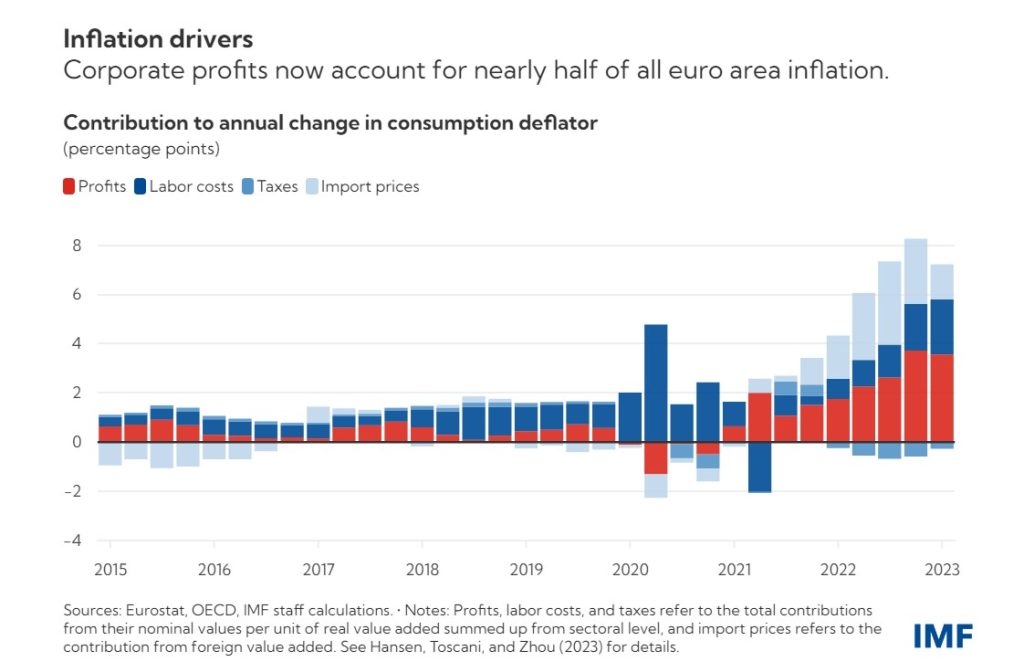
Rising corporate profits have caused 45% of inflation in Europe, compared to 40% for rising import prices and just 15% for workers’ wages, according to research by IMF economists.

By Ben Norton       Published 6/26/2023


Corporate profits have been the biggest contributor to inflation in Europe since 2021.

This is according to a study published by the International Monetary Fund (IMF).

Rising corporate profits account for almost half the increase in Europe’s inflation over the past two years as companies increased prices by more than spiking costs of imported energy”, wrote IMF economists this June.

The IMF said “companies may have to accept a smaller profit share if inflation is to remain on track to reach the European Central Bank’s 2-percent target in 2025”.

IMF economists Niels-Jakob Hansen, Frederik Toscani, and Jing Zhou detailed their findings in a research paper, “Euro Area Inflation after the Pandemic and Energy Shock: Import Prices, Profits and Wages”.

They found that domestic profits were responsible for 45% of the average change in consumption deflator (inflation) from the first quarter of 2022 to the first quarter of 2023, whereas rising import prices contributed 40%.

inflation profits labor import prices graph IMF

Some of the main factors contributing to rising import prices have included supply-chain disruptions due to the Covid-19 pandemic, the war in Ukraine, and Western sanctions on Russia – one of the world’s leading producers of oil, gas, fertilizer, and wheat – which caused a big spike in global commodity prices.

However, the share of inflation caused by import prices reached its peak in mid-2022 and has since been falling.

This suggests that post-pandemic supply-chain problems have largely been solved, and some commodity prices have dropped. But corporations have continued hiking prices anyway.

The IMF economists noted that “the results show that firms have passed on more than the nominal cost shock, and have fared relatively better than workers”.

Many neoliberal economists and Western central bank officials have ignored the rise in corporate profits, however, and instead blamed inflation on workers’ wages.

In response to the inflation that shot up as the world came out the pandemic, the European Central Bank and US Federal Reserve have been aggressively raising interest rates, at a speed not seen since the Volcker Shock of the 1980s.

Fed chair Jerome Powell admitted that his goal is to “get wages down”.

Former US Treasury Secretary and World Bank chief economist Larry Summers called for five years at 6% unemployment or a year at 10% unemployment in order to bring down inflation.

They put the blame largely on workers, overlooking how companies have exploited a time of uncertainty to make a killing.

[See here for related article.]

Economist Isabella Weber was correct about ‘sellers’ inflation’

Perhaps the most vocal economist in calling for her discipline to research how corporations have contributed to inflation in the past two years is Isabella M. Weber.

A professor at the University of Massachusetts Amherst, Weber has dubbed this “sellers’ inflation”.

Yet, while her work is meticulously sourced, Weber has faced harsh criticism from neoliberal economists.

In December 2021, she published an op-ed in The Guardian titled “Could strategic price controls help fight inflation?

In the debates around inflation, “a critical factor that is driving up prices remains largely overlooked: an explosion in profits”, Weber wrote. “In 2021, US non-financial profit margins have reached levels not seen since the aftermath of the second world war. This is no coincidence”.

She noted that “large corporations with market power have used supply problems as an opportunity to increase prices and scoop windfall profits”.

Weber’s article set off a firestorm, and she was brutally attacked. New York Times pundit Paul Krugman claimed Weber’s call for price controls was “truly stupid”.

corporate profits after tax 1970 2023 graph

In February 2023, Weber published an academic article further explaining the phenomenon: “Sellers’ Inflation, Profits and Conflict: Why can Large Firms Hike Prices in an Emergency?”

The IMF economists in fact cited this Weber article in their own working paper on inflation in Europe.

Rethinking inflation

Contemporary mainstream economists typically discuss three types of inflation: demand-pull inflation, cost-push inflation, and built-in inflation.

Cost-push inflation happens when the prices of inputs used in the production process increase. When the international prices of commodities like oil or gas skyrocket, in response to the war in Ukraine for instance, this contributes to cost-push inflation.

Built-in inflation accounts for expectations that inflation that happened in the past will repeat in the future. Corporations often increase their prices every year, for example, simply because they expect costs to increase, not because they actually did increase (but by doing so, costs do sometimes increase).

However, discussions of inflation among Western neoliberal economists are usually focused on demand-pull inflation.

The godfather of monetarism, infamous right-wing University of Chicago economist Milton Friedman, argued that “inflation is always and everywhere a monetary phenomenon”, and specifically consisted of demand-pull inflation: “too much money chasing too few goods”.

Friedman was an inspiration for Chile’s fascist dictator Augusto Pinochet, who came to power in 1973 in a CIA-backed military coup against the South American nation’s democratically elected socialist president, Salvador Allende.

Friedman was so fixated on government monetary policy that he essentially argued that cost-push inflation doesn’t exist, claiming it was merely a product of demand-pull inflation.

But this recent IMF study shows that the right-wing, monetarist view of inflation is much too simplistic. Capitalist firms can cause inflation simply by hiking up their profits to unreasonable levels.

Nevertheless, some monetarist holdovers today still insist that the inflation the world saw following the Covid-19 pandemic was merely caused by central bank money printing.

This fails to explain why there was little consumer price index inflation in the first 12 years of quantitative easing (QE), from 2008 to 2020, before the pandemic hit, and why QE suddenly caused prices to rise only around 2021.

fed balance sheet june 1 2023

Economist Michael Hudson has pointed out that QE by the US Federal Reserve and European Central Bank in fact fueled asset price inflation, not consumer price index inflation.

In an interview with Geopolitical Economy Report in September 2022, Hudson explained:

The result [of quantitative easing] has been $9 trillion, essentially, of bank liquidity that the Federal Reserve has pushed in.

Now, despite the fact that it is asset price inflation, the fact is that asset price inflation has all occurred on credit.

The asset price inflation has occurred when the Federal Reserve makes basically repo swaps with the banks, enabling the banks to deposit some of their packaged mortgage loans, or bonds, government bonds or even junk bonds, with the Fed.

And they get a deposit with the Fed that enables them to now turn around, as if the Fed was depositing money in the bank like a depositor, letting it lend more, and more, and more for real estate, which has pushed up the price.

Real estate is worth whatever a bank will lend against it. And the banks have been lowering the margin requirements, easing the the terms of the loan.

So the banks have inflated the real estate market, and also the stock and bond market.

The bond market from 2008 today has had the biggest bond rally in history. You can imagine the bond prices going down to below 0%. This is a huge capitalization of the bond rate.

So it has been a bonanza for people who held bonds, especially bank bonds. And it has inflated the top of the pyramid.

But if you inflate it on debt, then somebody has to pay the debt. And the debt, as I just said, is the 90% of the population.

So the fact is that asset price inflation and debt deflation go together, because the wealth part of the economy, the ownership part, has been vastly inflated, the price of wealth relative to labor.

But the debtor part has been has been squeezed by families having to pay much more of their income on mortgages, or credit cards, or student debt, leaving less and less to purchase goods and services.

So if there is a debt deflation, then why do we have a price inflation now? Well, the price inflation is largely a result of the war [in Ukraine], the sanctions that the United States has imposed on Russia.

Russia was, as you know, a major gas exporter, oil exporter, and also the largest agricultural exporter in the world.

So if you exclude Russian oil, Russian gas, Russian agriculture from the market, you’re going to have a shortage of supply, and you’re going to have the prices way up.

So the oil, energy, and food have been a key element.

And also, under the Biden administration and certainly the Trump administration, there has been no enforcement of monopoly prices.

So essentially companies have been using their monopoly power to charge whatever they want.

And even though there wasn’t really a shortage of gas or of oil earlier this year (2022), you had a huge spike in the price, for no other reason than the fact that the oil companies could charge it.

Partly this was done by financial manipulations in the forward markets. The financial markets had bid up the price of oil and gas. But also other companies have.

And right across the board, if you have a company in a commanding position of being able to control the market, you have essentially permitted monopolies to take place.

Well, Biden had appointed a number of anti-monopoly officials that were going to try to impose anti-monopoly legislation. But they’re not supported by the Democratic Party or the Republican Party enough to really empower them to have had much effect so far.


Monday, June 12, 2023

"A Chaotic Re-Sorting: Europe’s ‘Seminal Shift’ Is (Broadly) Moving in the Same Direction as U.S. Politics" by Alastair Crooke


Click here for Exit the Cuckoo's Nest's posting standards and aims. 

Click here to sign the People's Proclamation and send it to everyone you know.


Source: Strategic Culture Foundation

A Chaotic Re-Sorting: Europe’s ‘Seminal Shift’ Is (Broadly) Moving in the Same Direction as U.S. Politics

Alastair Crooke
    
June 12, 2023

Europe it seems is (broadly) moving in the same direction as U.S. politics, Alastair Crooke writes.

The backlash has started. It has been slow to emerge, and is lagging that of the U.S., yet it has begun in earnest. It is, as Wolfgang Münchau, a former FT journalist and editor of EuroIntelligence, has observed: “a seminal shift (for Europe), with important consequences”.

It is likely to reshape politics along a new fault-line: No longer the banal issues of ‘uni-party’ (pro-Establishment) politics: marginal tax rates; easy monetary ‘fixes’ and the consequent debt that would accumulate. But rather, it would find expression in the confrontation between those wishing for a Green upending of human society; a ‘Trans’ world for children; easy immigration; the radical re-ordering of power between ‘Identity’ groups in society – and those viscerally opposed to all of the above.

In Germany, this evolution is at ‘break-out’: Chancellor Scholtz’s coalition is in deep trouble. There is an anti-Green backlash. Support for the Green Party has crashed to 13% in the latest poll. In contrast, the party of the alt-Right AfD is attracting approximately one in five Germans who are ready to vote for it.

The “CDU and other parties of the European Centre-Right previously had courted the Greens as potential future coalition partners. Now they view them as their main political opponents”, Münchau states.

Put bluntly, whilst most Europeans indeed are Environmentalists (to one extent or another), it has become clear to many that that the Green extremist ideology is so ‘Green Utopian’ that its vanguard is prepared to destroy human society (or put it into permanent lockdown) ‘to save it’. But Green zealotry on top of de-industrialisation and soaring inflation is too much for Germans to bear:

‘Forget the EU as a model’, suggested EuroIntelligence in May:

The EU no longer serves as a role model for others … by being completely engulfed with its own green agenda, [the EU seems] to have forgotten that there is another world out there that needs to partake in those efforts for it to be effective at the global level Would [it] not constitute real leadership rather than the introspective, self-righteous way of how we go about right now? … we need to let go of these sacrifice-based ideologies. They are too expensive for our economies. Instead we need more innovation and more finance to realise those. Most of all, we have to stop seeing ourselves as a role model for the world”.

Germans are becoming increasingly receptive too, to the AfD’s positions on mass immigration – as the German government moves to liberalize immigration laws and to naturalize millions of foreigners as German citizens. The AfD is drawing support too, due to its opposition to sanctions against Russia which, it argues, are weakening the German economy and leading to de-industrialization.

But what really had Germans in a fluster was an article in Die Zeit that claimed Germany will soon be “a country in which migrants will no longer be a minority … Integration was yesterday: Germany is the second-largest immigration country in the world, and the original Germans are likely to become a numerical minority among many in the foreseeable future”.

Many in Germany were left to ruminate on whether the dilution of the native German population was simply a ‘business necessity’, or deliberate ‘identity engineering’ – or even, identity rotation. The issue was hinted at too, in the UK, by Nigel Farage, who lambasted the “dishonest, globalist” UK government’s addiction to cheap imported labour. (Note the globalist tag attached to the Conservatives.)

Other signs of this incipient political realignment are evident in France (with a pronounced swing to the Right), and in Spain (where an unexpected snap election was called, following a sharp swing to the Right there too, in local elections). In the Netherlands also, angry voters swept to victory on an agenda to oppose nitrogen emission cuts (and the mandatory mass culling of cattle). And in Austria and Slovakia, pro-Russian parties are surging.

Anger grows as public discourse debates endlessly ‘the absurd’ (“what is a woman?”), whilst everyone gives up on ever fixing the deeper issues at stake. What gives this situation its particular air of futility is that no one seriously believes Europe will do what would be necessary to correct the deeper malaise – the impossibility to continue doing what it has been doing, matched only by the impossibility of doing anything other.

Of course, in Europe, the Right is not all the same, but the components are (albeit in a differing mixes).

As such, the European backlash is of a piece with the crisis of legitimacy bearing down on all western societies today, Malcom Kyeyune has remarked.

“The ruling elite is increasingly angry and bitter that the ruled no longer listen; the ruled, for their part, are bitter that the system so obviously doesn’t act in their interest, nor does it even really pretend to anymore. We might actually wake up one day only to find that neither politicians nor voters think ‘democracy’ is doing very much to help them anymore”.

In France, extraordinary political events have become the New Normal. Kyeyune notes:

“Reforms are increasingly impossible, mistrust in the political system is increasing year by year, and basic legitimacy is slowly leaking out of parliamentary proceedings. If President Macron senses that France is slowly becoming ungovernable without extraordinary—and politically dubious—executive measures, he probably isn’t wrong, and he is far from the only Western leader to face this quandary”.

“Last week, Democratic presidential candidate Robert Kennedy appeared on a Twitter Spaces panel co-hosted by Elon Musk, Tulsi Gabbard, and venture capitalist David Sacks. He spoke for over two hours on a range of issues, including the war in Ukraine, energy policy, gun control, and the origin of SARS-CoV-2. Kennedy deplored the corporate takeover of the Democratic Party; excoriated President Biden’s pro-war instincts; decried the domination of U.S. foreign policy by neo-cons – and promoted renewable energy”.

“And yet, according to the New York Times and CNN, it was an orgy of right-wing conspiracy theorizing. “Robert F. Kennedy Jr., a scion of one of the country’s most famous Democratic families,” wrote three New York Times reporters: “dived into the full embrace of a host of conservative figures who eagerly promoted his long-shot primary challenge to President Biden … On Monday, he sounded like a candidate far more at ease in the mushrooming Republican presidential contest.”

“In an earlier era, Kennedy, would have been universally regarded as a far-left candidate in the mould of Ralph Nader … Kennedy believes that the war in Ukraine is being fuelled by “the neo-cons in the White House” who want regime change in Russia. In his campaign announcement speech, he described his mission as ending “the corrupt merger of state and corporate power” that is threatening “to impose a new kind of corporate feudalism in our country.”

It is a dizzying political realignment – scrambling all of the traditional categories and leaving in its wake just two sides: not left and right, but insider and outsider. And no matter the substance of one’s beliefs, to the media, “outsider” means by default, “right-wing conspiracy theorist”.

And predictably, it has aroused a torrent of abuse and anger:

“Kennedy’s “crackpot claims” and “outlandish views” have won him “favour on the Right,” Vanity Fair moaned.

“Mr. Kennedy has found another benefactor who seems to enjoy deluging the press with excrement: Elon Musk”, snarled The Independent.

“Robert F. Kennedy Jr. Spends an Hour Sucking Up to Elon Musk in Twitter Space,” blared a New Republic headline …

Rolling Stone sneered at his “outlandish and pseudoscientific ideas” and labelled Kennedy a “fringe candidate” with “crank beliefs.”

Esquire called him a “raving anti-vaxxer” and lambasted the very idea of having a contested Democratic primary”, Shellenberger and Woodhouse write.

There you have it: To speak critically (as Michael Scherer wrote in the Washington Post), is to be a “conspiracy theorist”.

The ‘dizzying political realignment’ well describes the nature of the European backlash too: European Centre-Right and Green coalitions saw the Ukraine conflict as the means to centralise ‘a new kind of feudalism’ in the EU; to disenfranchise European national parliaments of their prerogatives; and to open the prospect for consolidating the strange metamorphosis of NATO from pure military alliance to an enlightened, progressive, peace alliance – pursuing ‘justice’, values and democracy in Ukraine.

With “the U.S. Democrats slowly becoming pro-corporate, pro-war, and pro-censorship”, said Kennedy, and with the “Republicans becoming anti-censorship, pro-civil liberties, and anti-war – there’s been a tremendous realignment.”

Europe it seems is (broadly) moving in the same direction as U.S. politics. The European Élites – like their U.S. Democratic counterparts – embraced war on Russia. The Euro-Élites have adopted massive MSM narrative and social control and have dismembered the basic civic norms of marriage between a man and a woman and biological gender to which many Europeans still adhere.

The European ‘outsiders’ have begun calling “Enough”! Yet they may expect to receive the same rough treatment from the main-stream media as Kennedy is receiving (whatever their views). The U.S. Deep State will stop at nothing to ensure that neither Kennedy – nor Trump – comes anywhere close to office. Brussels will act in parallel, in Europe.

Where is this realignment all leading? Well, we are in a chaotic re-sorting period right now. Kennedy, a Democrat, accused of MAGA-ism?? Extraordinary! Class politics it is not. It is a new realignment, scrambling old categories. And a shift in core values between ‘outsiders’ and their rulers. One reason that this will be very difficult to decipher is that outsiders now view ‘democracy’ with growing mistrust. Will that result in tactical voting? Does ‘Right’ or ‘Left’ have much meaning when a Kennedy is accused of MAGA sympathies?

Disqus